












Friday, October 9, 2026
  • English
    • Arabic
    • Dutch
    • English
    • French
    • German
    • Hindi
    • Italian
    • Portuguese
    • Russian
    • Spanish
Modern Agriculture India
Advertisement
  • Home
  • News
    Transforming Manufacturing: TAGMA’s Next-Gen Tooling Showcase at 2026 Expo

    Transforming Manufacturing: TAGMA’s Next-Gen Tooling Showcase at 2026 Expo

    Texas Agriculture Issues Urgent Alert As Invasive Pest Detected In Multiple Counties, Including Houston Area

    Texas Agriculture Issues Urgent Alert As Invasive Pest Detected In Multiple Counties, Including Houston Area

    USDA Launches New Regenerative Pilot Program To Lower Farmer Production Costs And Advance MAHA Agenda

    USDA Launches New Regenerative Pilot Program To Lower Farmer Production Costs And Advance MAHA Agenda

    Shibu Jose Joins Global Council Of The World Agriculture Forum (WAF)

    Shibu Jose Joins Global Council Of The World Agriculture Forum (WAF)

    India’s First Edible Oil Consumption Survey Underway

    India’s First Edible Oil Consumption Survey Underway

    Prime Minister Sets Out AI Action Plan At UCL

    Prime Minister Sets Out AI Action Plan At UCL

    UAE To Develop Lander For Emirates Asteroid Belt Mission

    UAE To Develop Lander For Emirates Asteroid Belt Mission

    US To Have Unlimited Access To Al Chips

    US To Have Unlimited Access To Al Chips

  • Agriculture
    Bionetix Unveils New Technology for Managing Drain System Buildup

    Bionetix Unveils New Technology for Managing Drain System Buildup

    Aries Agro Q1 FY27 Results Highlight 49% Surge in Consolidated PAT

    Aries Agro Q1 FY27 Results Highlight 49% Surge in Consolidated PAT

    Westfalia Fruit Advances Its Vision for Avocado Growth Across Asia

    Westfalia Fruit Advances Its Vision for Avocado Growth Across Asia

    South India Agriculture Conference Pushes Digital Farming, Precision Agriculture and Climate-Resilient Agriculture

    South India Agriculture Conference Pushes Digital Farming, Precision Agriculture and Climate-Resilient Agriculture

    Uneven Monsoon Raises Concerns Over India’s Kharif Crop Output as Harvest Season Nears

    Uneven Monsoon Raises Concerns Over India’s Kharif Crop Output as Harvest Season Nears

    FAO Calls for Better Climate Finance to Strengthen Global Agrifood Systems

    FAO Calls for Better Climate Finance to Strengthen Global Agrifood Systems

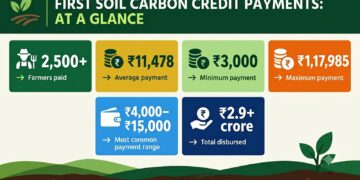
    India Begins Soil-Carbon Payments to Farmers, Opening a New Revenue Opportunity for Sustainable Agriculture  **NEW DELHI:** India has begun making payments to farmers linked to verified soil-carbon credits, marking a significant development in the country’s efforts to connect sustainable farming practices with emerging carbon markets.  More than **2,500 farmers across Punjab and Haryana** are receiving payments associated with measured improvements in soil carbon, according to reports on the initiative. The development offers a new potential source of income for farmers while encouraging agricultural practices aimed at improving soil health and reducing greenhouse-gas emissions.  The initiative comes as agriculture faces growing pressure to increase productivity while protecting natural resources. Continuous cultivation, excessive tillage, inefficient fertiliser use and declining soil organic matter can affect soil quality over time. Carbon-focused farming practices seek to address some of these challenges by increasing the amount of carbon stored in agricultural soils.  ## What Are Soil-Carbon Credits?  Soil-carbon credits are linked to the amount of carbon that agricultural practices can help remove from the atmosphere or retain in soil.  Farmers can potentially generate credits by adopting practices that increase soil organic carbon or reduce emissions. Depending on the methodology used, these practices can include **reduced or zero tillage, improved residue management, cover crops, crop diversification, efficient fertiliser use and other regenerative farming techniques**.  Credits are generally based on measured or verified changes rather than simply on whether a farmer has adopted a particular practice.  This distinction is important because carbon markets require evidence that claimed emissions reductions or carbon storage have actually occurred.  ## Creating an Additional Income Stream  For farmers, the most significant feature of carbon farming is the possibility of receiving income beyond conventional crop sales.  Agricultural revenue can fluctuate considerably because of weather, input prices, crop prices and market conditions. Payments associated with verified environmental outcomes could potentially provide farmers with an additional source of income.  The emerging model links a farmer’s land-management decisions with demand from organisations seeking to account for or compensate for greenhouse-gas emissions.  If carbon markets continue to develop, farmers who adopt suitable practices could potentially earn additional payments while also improving the long-term condition of their soil.  ## Why Soil Health Matters  Soil is one of agriculture’s most important natural resources.  Healthy soils contain organic matter that supports soil structure, water retention and biological activity. Increasing soil organic carbon can contribute to improved soil quality, although the effects depend on local conditions, crop systems and management practices.  Improved soil structure can potentially help fields retain water and withstand periods of moisture stress.  For Indian agriculture, this is particularly relevant as farmers in many regions face increasing pressure from irregular rainfall and water availability.  Better soil management can therefore have benefits that extend beyond carbon accounting.  ## Farmers and Regenerative Agriculture  The growth of soil-carbon programmes is also encouraging greater interest in **regenerative and climate-smart agriculture**.  These approaches generally focus on improving soil health while maintaining or increasing agricultural productivity.  Practices such as reduced tillage can limit soil disturbance. Keeping crop residues in fields can return organic material to the soil. Cover crops can protect soil between production cycles, while crop diversification can support soil biological activity.  However, no single practice is suitable for every farm.  Farmers need to consider local soil characteristics, water availability, crop requirements, machinery, labour and economics before changing their production systems.  ## Measuring Carbon Is a Critical Step  One of the biggest challenges in soil-carbon markets is determining how much carbon has actually been stored.  Unlike a manufactured product, soil carbon can change over time because of weather, cultivation and biological processes.  Carbon-credit programmes therefore need systems for **measurement, reporting and verification**.  Soil samples, field records, remote sensing, modelling and other monitoring methods can be combined to estimate changes in soil carbon.  Reliable verification is essential because buyers of carbon credits need confidence that the environmental benefit represented by a credit is real.  For farmers, accurate measurement is equally important because payments depend on the amount of verified carbon benefits attributed to their land.  ## The Importance of Long-Term Monitoring  Soil-carbon storage is not necessarily permanent.  Carbon levels can decline if land-management practices are reversed. For example, a farmer who moves toward reduced tillage and improved residue management may increase soil carbon over time, but changes in future farming practices could affect those gains.  This means carbon programmes need long-term monitoring rather than relying only on a one-time measurement.  Clear rules around monitoring, verification and the duration of carbon storage will be important as India’s agricultural carbon market develops.  ## Punjab and Haryana at the Centre of the Initiative  Punjab and Haryana have particular significance in India’s agricultural landscape.  The two states are major contributors to the country’s food production, particularly through intensive cereal-based farming systems.  At the same time, intensive agriculture has created concerns around soil health, water use and crop-residue management.  This makes the region an important testing ground for approaches that attempt to combine farm productivity with environmental improvements.  If carbon-linked payments prove economically viable, they could provide farmers with an additional incentive to experiment with improved soil-management practices.  ## Carbon Markets and Indian Agriculture  The emergence of agricultural carbon credits reflects the broader development of India’s carbon-market ecosystem.  Carbon markets are designed to create an economic value for emissions reductions or carbon removal. Companies and other organisations may purchase credits depending on regulatory requirements, voluntary commitments or other market mechanisms.  Agriculture represents a potentially large area of opportunity because soils, vegetation and agricultural practices interact directly with the carbon cycle.  However, agricultural carbon markets are still developing, and their long-term impact will depend on the quality of crediting methodologies, market demand and the costs associated with monitoring and verification.  ## Technology Could Lower the Cost of Participation  Digital technologies could play an increasingly important role in expanding soil-carbon programmes.  Satellite imagery can help monitor agricultural land, while digital farm records can provide information about crop rotations and field practices. Soil sensors and improved sampling techniques can provide additional data.  Artificial intelligence and machine-learning models may also help analyse large quantities of agricultural and environmental information.  The use of technology could eventually reduce the cost of measuring and verifying carbon outcomes, making smaller farms more practical participants in carbon markets.  ## Making Carbon Farming Accessible to Small Farmers  India’s agricultural landscape is dominated by small and marginal farmers, which means that accessibility will be critical.  If carbon-credit programmes involve expensive testing, complicated contracts or high administrative costs, smaller farmers may struggle to participate.  Programmes that aggregate farmers across multiple villages or regions could potentially reduce these costs.  Farmer-producer organisations, cooperatives and other agricultural institutions could also play a role by helping farmers understand carbon programmes, coordinate participation and access technical assistance.

    India Begins Soil-Carbon Payments to Farmers, Opening a New Revenue Opportunity for Sustainable Agriculture **NEW DELHI:** India has begun making payments to farmers linked to verified soil-carbon credits, marking a significant development in the country’s efforts to connect sustainable farming practices with emerging carbon markets. More than **2,500 farmers across Punjab and Haryana** are receiving payments associated with measured improvements in soil carbon, according to reports on the initiative. The development offers a new potential source of income for farmers while encouraging agricultural practices aimed at improving soil health and reducing greenhouse-gas emissions. The initiative comes as agriculture faces growing pressure to increase productivity while protecting natural resources. Continuous cultivation, excessive tillage, inefficient fertiliser use and declining soil organic matter can affect soil quality over time. Carbon-focused farming practices seek to address some of these challenges by increasing the amount of carbon stored in agricultural soils. ## What Are Soil-Carbon Credits? Soil-carbon credits are linked to the amount of carbon that agricultural practices can help remove from the atmosphere or retain in soil. Farmers can potentially generate credits by adopting practices that increase soil organic carbon or reduce emissions. Depending on the methodology used, these practices can include **reduced or zero tillage, improved residue management, cover crops, crop diversification, efficient fertiliser use and other regenerative farming techniques**. Credits are generally based on measured or verified changes rather than simply on whether a farmer has adopted a particular practice. This distinction is important because carbon markets require evidence that claimed emissions reductions or carbon storage have actually occurred. ## Creating an Additional Income Stream For farmers, the most significant feature of carbon farming is the possibility of receiving income beyond conventional crop sales. Agricultural revenue can fluctuate considerably because of weather, input prices, crop prices and market conditions. Payments associated with verified environmental outcomes could potentially provide farmers with an additional source of income. The emerging model links a farmer’s land-management decisions with demand from organisations seeking to account for or compensate for greenhouse-gas emissions. If carbon markets continue to develop, farmers who adopt suitable practices could potentially earn additional payments while also improving the long-term condition of their soil. ## Why Soil Health Matters Soil is one of agriculture’s most important natural resources. Healthy soils contain organic matter that supports soil structure, water retention and biological activity. Increasing soil organic carbon can contribute to improved soil quality, although the effects depend on local conditions, crop systems and management practices. Improved soil structure can potentially help fields retain water and withstand periods of moisture stress. For Indian agriculture, this is particularly relevant as farmers in many regions face increasing pressure from irregular rainfall and water availability. Better soil management can therefore have benefits that extend beyond carbon accounting. ## Farmers and Regenerative Agriculture The growth of soil-carbon programmes is also encouraging greater interest in **regenerative and climate-smart agriculture**. These approaches generally focus on improving soil health while maintaining or increasing agricultural productivity. Practices such as reduced tillage can limit soil disturbance. Keeping crop residues in fields can return organic material to the soil. Cover crops can protect soil between production cycles, while crop diversification can support soil biological activity. However, no single practice is suitable for every farm. Farmers need to consider local soil characteristics, water availability, crop requirements, machinery, labour and economics before changing their production systems. ## Measuring Carbon Is a Critical Step One of the biggest challenges in soil-carbon markets is determining how much carbon has actually been stored. Unlike a manufactured product, soil carbon can change over time because of weather, cultivation and biological processes. Carbon-credit programmes therefore need systems for **measurement, reporting and verification**. Soil samples, field records, remote sensing, modelling and other monitoring methods can be combined to estimate changes in soil carbon. Reliable verification is essential because buyers of carbon credits need confidence that the environmental benefit represented by a credit is real. For farmers, accurate measurement is equally important because payments depend on the amount of verified carbon benefits attributed to their land. ## The Importance of Long-Term Monitoring Soil-carbon storage is not necessarily permanent. Carbon levels can decline if land-management practices are reversed. For example, a farmer who moves toward reduced tillage and improved residue management may increase soil carbon over time, but changes in future farming practices could affect those gains. This means carbon programmes need long-term monitoring rather than relying only on a one-time measurement. Clear rules around monitoring, verification and the duration of carbon storage will be important as India’s agricultural carbon market develops. ## Punjab and Haryana at the Centre of the Initiative Punjab and Haryana have particular significance in India’s agricultural landscape. The two states are major contributors to the country’s food production, particularly through intensive cereal-based farming systems. At the same time, intensive agriculture has created concerns around soil health, water use and crop-residue management. This makes the region an important testing ground for approaches that attempt to combine farm productivity with environmental improvements. If carbon-linked payments prove economically viable, they could provide farmers with an additional incentive to experiment with improved soil-management practices. ## Carbon Markets and Indian Agriculture The emergence of agricultural carbon credits reflects the broader development of India’s carbon-market ecosystem. Carbon markets are designed to create an economic value for emissions reductions or carbon removal. Companies and other organisations may purchase credits depending on regulatory requirements, voluntary commitments or other market mechanisms. Agriculture represents a potentially large area of opportunity because soils, vegetation and agricultural practices interact directly with the carbon cycle. However, agricultural carbon markets are still developing, and their long-term impact will depend on the quality of crediting methodologies, market demand and the costs associated with monitoring and verification. ## Technology Could Lower the Cost of Participation Digital technologies could play an increasingly important role in expanding soil-carbon programmes. Satellite imagery can help monitor agricultural land, while digital farm records can provide information about crop rotations and field practices. Soil sensors and improved sampling techniques can provide additional data. Artificial intelligence and machine-learning models may also help analyse large quantities of agricultural and environmental information. The use of technology could eventually reduce the cost of measuring and verifying carbon outcomes, making smaller farms more practical participants in carbon markets. ## Making Carbon Farming Accessible to Small Farmers India’s agricultural landscape is dominated by small and marginal farmers, which means that accessibility will be critical. If carbon-credit programmes involve expensive testing, complicated contracts or high administrative costs, smaller farmers may struggle to participate. Programmes that aggregate farmers across multiple villages or regions could potentially reduce these costs. Farmer-producer organisations, cooperatives and other agricultural institutions could also play a role by helping farmers understand carbon programmes, coordinate participation and access technical assistance.

    BRICS New Delhi Summit Puts Focus on Agro-Ecology, Digital and Climate-Resilient Agriculture

    BRICS New Delhi Summit Puts Focus on Agro-Ecology, Digital and Climate-Resilient Agriculture

  • Farmers
    Shivraj Singh Chouhan Highlights PM-KISAN Milestone in Patna: Empowering India’s Farmers

    Shivraj Singh Chouhan Highlights PM-KISAN Milestone in Patna: Empowering India’s Farmers

    Gau Sampurna: Revolutionizing Livestock Management for India’s Farmers

    Gau Sampurna: Revolutionizing Livestock Management for India’s Farmers

    VK Packwell: Transforming Indian Agriculture with Affordable & Innovative Irrigation Solutions

    VK Packwell: Transforming Indian Agriculture with Affordable & Innovative Irrigation Solutions

    India has three cropping seasons -- summer, kharif, and rabi.

    India’s kharif crop planting area rises; paddy leading year-on-year

    Robust rains accelerate rice planting in India

    Robust rains accelerate rice planting in India

    Govt says crop insurance claims worth Rs 2,761.10 cr pending under PMFBY till 2021-22

    Govt says crop insurance claims worth Rs 2,761.10 cr pending under PMFBY till 2021-22

    India's rice planting gathers pace as monsoon rains revive

    India’s rice planting gathers pace as monsoon rains revive

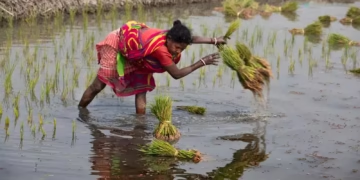
    Farm labourers plant rice saplings in a field on the outskirts of Ahmedabad, India, July 21, 2023. REUTER

    Rice planting gathers pace as monsoon rains revive

  • technology
    New Holland’s ‘Super Safar’: A Customer-Led Journey Through Haryana and Punjab

    New Holland’s ‘Super Safar’: A Customer-Led Journey Through Haryana and Punjab

    Indian Car Makers Plan Major Manufacturing Expansion After Record Gst-Driven Sales

    Indian Car Makers Plan Major Manufacturing Expansion After Record Gst-Driven Sales

    AI for Bharat: Revolutionizing Agriculture, Healthcare, and Education

    AI for Bharat: Revolutionizing Agriculture, Healthcare, and Education

    Driving Transparency: KOLTIVA Leads Sustainable Agribusiness Innovation at Agri Vietnam 2025

    Driving Transparency: KOLTIVA Leads Sustainable Agribusiness Innovation at Agri Vietnam 2025

    AI Leadership: A New Era of Innovation in Information Management

    AI Leadership: A New Era of Innovation in Information Management

    Prime Minister Sets Out AI Action Plan At UCL

    Prime Minister Sets Out AI Action Plan At UCL

    COLINES Innovative Cast MOPE Film for Printing on Show at DRUPA Event

    COLINES Innovative Cast MOPE Film for Printing on Show at DRUPA Event

    Ola Cloud Migration: Shifting IT Workload From AWS After Exiting Microsoft Azure

    Ola Cloud Migration: Shifting IT Workload From AWS After Exiting Microsoft Azure

  • Research
    HarvestPlus and Odisha University of Agriculture and Technology Join Forces to Accelerate Biofortification Research in India

    HarvestPlus and Odisha University of Agriculture and Technology Join Forces to Accelerate Biofortification Research in India

    There are four priority areas on which focused discussions will take place: food security and nutrition, sustainable agriculture through approaches of climate resilient agriculture, digitisation for agricultural transformation and public-private partnerships for research and development in the sector, an official said

    G20 MACS to focus on sustainable agriculture, food security

    Growth dips, public investment stagnant in agriculture sector

    Growth dips, public investment stagnant in agriculture sector

    State requires an outlook report to remove uncertainty in agriculture: CM

    State requires an outlook report to remove uncertainty in agriculture: CM

    Crop waste cattle feed solution ‘averts toxic fires’

    Crop waste cattle feed solution ‘averts toxic fires’

    There is need to intensify agricultural research: Minister

    There is need to intensify agricultural research: Minister

  • Economy
    India to host World Coffee Conference for first time in September

    India to host World Coffee Conference for first time in September

    India's agriculture and food inflation face challenges from erratic rains and El Nino

    India’s agriculture and food inflation face challenges from erratic rains and El Nino

    Explained: How D2C Organic Farming Is Also Empowering Local Communities

    Explained: How D2C Organic Farming Is Also Empowering Local Communities

    India can become sustainable fuel hub by using agri waste: Honeywell

    India can become sustainable fuel hub by using agri waste: Honeywell

    Sahakar Se Samriddhi: 2,500 Kisan Drones To Be Procured By IFFCO For Sustainable Agriculture

    Sahakar Se Samriddhi: 2,500 Kisan Drones To Be Procured By IFFCO For Sustainable Agriculture

    Small dairy farmers: The backbone of Indian dairy

    Small dairy farmers: The backbone of Indian dairy

    Farmers face various challenges while transitioning to organic/natural farming, including a lack of knowledge, non-availability of quality organic and bio-inputs, as well as a lack of market support to get fair and remunerative prices.

    Union Budget 2023-24: India’s farmers can take to organic agriculture with proper support

    Challenges faced by farmers due to climate change have further exacerbated the food insecurity situation across India

    Opinion | From Crop Failure to Food Security: How Climate Change Affects Farmers and Communities

  • India
    New Holland’s ‘Super Safar’: A Customer-Led Journey Through Haryana and Punjab

    New Holland’s ‘Super Safar’: A Customer-Led Journey Through Haryana and Punjab

    Manipal University Jaipur Launches International Innovation Challenge IIC 3.0

    Manipal University Jaipur Launches International Innovation Challenge IIC 3.0

    Ethereal Machines Raises US$13 Million to Boost Advanced Manufacturing in India

    Ethereal Machines Raises US$13 Million to Boost Advanced Manufacturing in India

    10th Ecowaste Exhibition & Forum To Create Blueprint For Addressing Region’s Waste Challenges

    10th Ecowaste Exhibition & Forum To Create Blueprint For Addressing Region’s Waste Challenges

    Pakka Limited and Brawny Bear Join Hands to Launch India’s First Compostable  Flexible Packaging

    Pakka Limited and Brawny Bear Join Hands to Launch India’s First Compostable Flexible Packaging

    SIG lays Foundation of its First Indian Aseptic Carton plant in Ahmedabad

    SIG lays Foundation of its First Indian Aseptic Carton plant in Ahmedabad

    VK Packwell: Transforming Indian Agriculture with Affordable & Innovative Irrigation Solutions

    VK Packwell: Transforming Indian Agriculture with Affordable & Innovative Irrigation Solutions

    Climate Change Leading to Erratic Agriculture in India

    Climate Change Leading to Erratic Agriculture in India

    India’s G20 Presidency Highlights Food Safety Net Programmes, Says Agriculture Ministry

    India’s G20 Presidency Highlights Food Safety Net Programmes, Says Agriculture Ministry

    • Rural
      Impact of Startups on Indian Agriculture and Rural Growth

      Impact of Startups on Indian Agriculture and Rural Growth

      Sahakar Se Samriddhi: 2,500 Kisan Drones To Be Procured By IFFCO For Sustainable Agriculture

      Sahakar Se Samriddhi: 2,500 Kisan Drones To Be Procured By IFFCO For Sustainable Agriculture

      Pioneering Pigeonpea Project Unveiled in India

      Pioneering Pigeonpea Project Unveiled in India

      Crop waste cattle feed solution ‘averts toxic fires’

      Crop waste cattle feed solution ‘averts toxic fires’

      Promoting Inclusive Business in Agriculture and Food Systems in India

      Promoting Inclusive Business in Agriculture and Food Systems in India

      Agri finance company Kissandhan eyes 15% of Farmers Producer Organisation business, signs up four FPOs in West Bengal

      Agri finance company Kissandhan eyes 15% of Farmers Producer Organisation business, signs up four FPOs in West Bengal

      Agro Tech 2022: Rural farmers bat for technology in agriculture

      Agro Tech 2022: Rural farmers bat for technology in agriculture

    • Startup
      Karsan’s 100% Electric Autonomous e-JEST  Hits the Roads in America

      Karsan’s 100% Electric Autonomous e-JEST Hits the Roads in America

      65 Startups Named to MedTech Innovator 2024 Cohort

      65 Startups Named to MedTech Innovator 2024 Cohort

      Yatra Unveils AI-Powered Tool to Help Smes, Large Enterprises Manage Expenses Efficiently

      Yatra Unveils AI-Powered Tool to Help Smes, Large Enterprises Manage Expenses Efficiently

      Vietnam Education Startup Prep Bags US$7 Million in Series A Funding

      Vietnam Education Startup Prep Bags US$7 Million in Series A Funding

      ’80-100 Hours a Week, No WFH’: Sachin Bansal on Building Fintech Startup Navi After Flipkart

      ’80-100 Hours a Week, No WFH’: Sachin Bansal on Building Fintech Startup Navi After Flipkart

      ‘Never had a Funding Winter… Good Firms Always had Enough Money to Back Them’: Sanjeev Bikhchandani

      ‘Never had a Funding Winter… Good Firms Always had Enough Money to Back Them’: Sanjeev Bikhchandani

      Amazon Invests US$2.75 Billion in AI Startup Anthropic

      Amazon Invests US$2.75 Billion in AI Startup Anthropic

      Agriculture Accelerator Fund To Encourage Startups: Finance Minister

      Agriculture Accelerator Fund To Encourage Startups: Finance Minister

      The agriculture budget has increased

      The agriculture budget has increased; we have now over 3,000 agri startups: PM Modi

  • Home
  • News
    Transforming Manufacturing: TAGMA’s Next-Gen Tooling Showcase at 2026 Expo

    Transforming Manufacturing: TAGMA’s Next-Gen Tooling Showcase at 2026 Expo

    Texas Agriculture Issues Urgent Alert As Invasive Pest Detected In Multiple Counties, Including Houston Area

    Texas Agriculture Issues Urgent Alert As Invasive Pest Detected In Multiple Counties, Including Houston Area

    USDA Launches New Regenerative Pilot Program To Lower Farmer Production Costs And Advance MAHA Agenda

    USDA Launches New Regenerative Pilot Program To Lower Farmer Production Costs And Advance MAHA Agenda

    Shibu Jose Joins Global Council Of The World Agriculture Forum (WAF)

    Shibu Jose Joins Global Council Of The World Agriculture Forum (WAF)

    India’s First Edible Oil Consumption Survey Underway

    India’s First Edible Oil Consumption Survey Underway

    Prime Minister Sets Out AI Action Plan At UCL

    Prime Minister Sets Out AI Action Plan At UCL

    UAE To Develop Lander For Emirates Asteroid Belt Mission

    UAE To Develop Lander For Emirates Asteroid Belt Mission

    US To Have Unlimited Access To Al Chips

    US To Have Unlimited Access To Al Chips

  • Agriculture
    Bionetix Unveils New Technology for Managing Drain System Buildup

    Bionetix Unveils New Technology for Managing Drain System Buildup

    Aries Agro Q1 FY27 Results Highlight 49% Surge in Consolidated PAT

    Aries Agro Q1 FY27 Results Highlight 49% Surge in Consolidated PAT

    Westfalia Fruit Advances Its Vision for Avocado Growth Across Asia

    Westfalia Fruit Advances Its Vision for Avocado Growth Across Asia

    South India Agriculture Conference Pushes Digital Farming, Precision Agriculture and Climate-Resilient Agriculture

    South India Agriculture Conference Pushes Digital Farming, Precision Agriculture and Climate-Resilient Agriculture

    Uneven Monsoon Raises Concerns Over India’s Kharif Crop Output as Harvest Season Nears

    Uneven Monsoon Raises Concerns Over India’s Kharif Crop Output as Harvest Season Nears

    FAO Calls for Better Climate Finance to Strengthen Global Agrifood Systems

    FAO Calls for Better Climate Finance to Strengthen Global Agrifood Systems

    India Begins Soil-Carbon Payments to Farmers, Opening a New Revenue Opportunity for Sustainable Agriculture  **NEW DELHI:** India has begun making payments to farmers linked to verified soil-carbon credits, marking a significant development in the country’s efforts to connect sustainable farming practices with emerging carbon markets.  More than **2,500 farmers across Punjab and Haryana** are receiving payments associated with measured improvements in soil carbon, according to reports on the initiative. The development offers a new potential source of income for farmers while encouraging agricultural practices aimed at improving soil health and reducing greenhouse-gas emissions.  The initiative comes as agriculture faces growing pressure to increase productivity while protecting natural resources. Continuous cultivation, excessive tillage, inefficient fertiliser use and declining soil organic matter can affect soil quality over time. Carbon-focused farming practices seek to address some of these challenges by increasing the amount of carbon stored in agricultural soils.  ## What Are Soil-Carbon Credits?  Soil-carbon credits are linked to the amount of carbon that agricultural practices can help remove from the atmosphere or retain in soil.  Farmers can potentially generate credits by adopting practices that increase soil organic carbon or reduce emissions. Depending on the methodology used, these practices can include **reduced or zero tillage, improved residue management, cover crops, crop diversification, efficient fertiliser use and other regenerative farming techniques**.  Credits are generally based on measured or verified changes rather than simply on whether a farmer has adopted a particular practice.  This distinction is important because carbon markets require evidence that claimed emissions reductions or carbon storage have actually occurred.  ## Creating an Additional Income Stream  For farmers, the most significant feature of carbon farming is the possibility of receiving income beyond conventional crop sales.  Agricultural revenue can fluctuate considerably because of weather, input prices, crop prices and market conditions. Payments associated with verified environmental outcomes could potentially provide farmers with an additional source of income.  The emerging model links a farmer’s land-management decisions with demand from organisations seeking to account for or compensate for greenhouse-gas emissions.  If carbon markets continue to develop, farmers who adopt suitable practices could potentially earn additional payments while also improving the long-term condition of their soil.  ## Why Soil Health Matters  Soil is one of agriculture’s most important natural resources.  Healthy soils contain organic matter that supports soil structure, water retention and biological activity. Increasing soil organic carbon can contribute to improved soil quality, although the effects depend on local conditions, crop systems and management practices.  Improved soil structure can potentially help fields retain water and withstand periods of moisture stress.  For Indian agriculture, this is particularly relevant as farmers in many regions face increasing pressure from irregular rainfall and water availability.  Better soil management can therefore have benefits that extend beyond carbon accounting.  ## Farmers and Regenerative Agriculture  The growth of soil-carbon programmes is also encouraging greater interest in **regenerative and climate-smart agriculture**.  These approaches generally focus on improving soil health while maintaining or increasing agricultural productivity.  Practices such as reduced tillage can limit soil disturbance. Keeping crop residues in fields can return organic material to the soil. Cover crops can protect soil between production cycles, while crop diversification can support soil biological activity.  However, no single practice is suitable for every farm.  Farmers need to consider local soil characteristics, water availability, crop requirements, machinery, labour and economics before changing their production systems.  ## Measuring Carbon Is a Critical Step  One of the biggest challenges in soil-carbon markets is determining how much carbon has actually been stored.  Unlike a manufactured product, soil carbon can change over time because of weather, cultivation and biological processes.  Carbon-credit programmes therefore need systems for **measurement, reporting and verification**.  Soil samples, field records, remote sensing, modelling and other monitoring methods can be combined to estimate changes in soil carbon.  Reliable verification is essential because buyers of carbon credits need confidence that the environmental benefit represented by a credit is real.  For farmers, accurate measurement is equally important because payments depend on the amount of verified carbon benefits attributed to their land.  ## The Importance of Long-Term Monitoring  Soil-carbon storage is not necessarily permanent.  Carbon levels can decline if land-management practices are reversed. For example, a farmer who moves toward reduced tillage and improved residue management may increase soil carbon over time, but changes in future farming practices could affect those gains.  This means carbon programmes need long-term monitoring rather than relying only on a one-time measurement.  Clear rules around monitoring, verification and the duration of carbon storage will be important as India’s agricultural carbon market develops.  ## Punjab and Haryana at the Centre of the Initiative  Punjab and Haryana have particular significance in India’s agricultural landscape.  The two states are major contributors to the country’s food production, particularly through intensive cereal-based farming systems.  At the same time, intensive agriculture has created concerns around soil health, water use and crop-residue management.  This makes the region an important testing ground for approaches that attempt to combine farm productivity with environmental improvements.  If carbon-linked payments prove economically viable, they could provide farmers with an additional incentive to experiment with improved soil-management practices.  ## Carbon Markets and Indian Agriculture  The emergence of agricultural carbon credits reflects the broader development of India’s carbon-market ecosystem.  Carbon markets are designed to create an economic value for emissions reductions or carbon removal. Companies and other organisations may purchase credits depending on regulatory requirements, voluntary commitments or other market mechanisms.  Agriculture represents a potentially large area of opportunity because soils, vegetation and agricultural practices interact directly with the carbon cycle.  However, agricultural carbon markets are still developing, and their long-term impact will depend on the quality of crediting methodologies, market demand and the costs associated with monitoring and verification.  ## Technology Could Lower the Cost of Participation  Digital technologies could play an increasingly important role in expanding soil-carbon programmes.  Satellite imagery can help monitor agricultural land, while digital farm records can provide information about crop rotations and field practices. Soil sensors and improved sampling techniques can provide additional data.  Artificial intelligence and machine-learning models may also help analyse large quantities of agricultural and environmental information.  The use of technology could eventually reduce the cost of measuring and verifying carbon outcomes, making smaller farms more practical participants in carbon markets.  ## Making Carbon Farming Accessible to Small Farmers  India’s agricultural landscape is dominated by small and marginal farmers, which means that accessibility will be critical.  If carbon-credit programmes involve expensive testing, complicated contracts or high administrative costs, smaller farmers may struggle to participate.  Programmes that aggregate farmers across multiple villages or regions could potentially reduce these costs.  Farmer-producer organisations, cooperatives and other agricultural institutions could also play a role by helping farmers understand carbon programmes, coordinate participation and access technical assistance.

    India Begins Soil-Carbon Payments to Farmers, Opening a New Revenue Opportunity for Sustainable Agriculture **NEW DELHI:** India has begun making payments to farmers linked to verified soil-carbon credits, marking a significant development in the country’s efforts to connect sustainable farming practices with emerging carbon markets. More than **2,500 farmers across Punjab and Haryana** are receiving payments associated with measured improvements in soil carbon, according to reports on the initiative. The development offers a new potential source of income for farmers while encouraging agricultural practices aimed at improving soil health and reducing greenhouse-gas emissions. The initiative comes as agriculture faces growing pressure to increase productivity while protecting natural resources. Continuous cultivation, excessive tillage, inefficient fertiliser use and declining soil organic matter can affect soil quality over time. Carbon-focused farming practices seek to address some of these challenges by increasing the amount of carbon stored in agricultural soils. ## What Are Soil-Carbon Credits? Soil-carbon credits are linked to the amount of carbon that agricultural practices can help remove from the atmosphere or retain in soil. Farmers can potentially generate credits by adopting practices that increase soil organic carbon or reduce emissions. Depending on the methodology used, these practices can include **reduced or zero tillage, improved residue management, cover crops, crop diversification, efficient fertiliser use and other regenerative farming techniques**. Credits are generally based on measured or verified changes rather than simply on whether a farmer has adopted a particular practice. This distinction is important because carbon markets require evidence that claimed emissions reductions or carbon storage have actually occurred. ## Creating an Additional Income Stream For farmers, the most significant feature of carbon farming is the possibility of receiving income beyond conventional crop sales. Agricultural revenue can fluctuate considerably because of weather, input prices, crop prices and market conditions. Payments associated with verified environmental outcomes could potentially provide farmers with an additional source of income. The emerging model links a farmer’s land-management decisions with demand from organisations seeking to account for or compensate for greenhouse-gas emissions. If carbon markets continue to develop, farmers who adopt suitable practices could potentially earn additional payments while also improving the long-term condition of their soil. ## Why Soil Health Matters Soil is one of agriculture’s most important natural resources. Healthy soils contain organic matter that supports soil structure, water retention and biological activity. Increasing soil organic carbon can contribute to improved soil quality, although the effects depend on local conditions, crop systems and management practices. Improved soil structure can potentially help fields retain water and withstand periods of moisture stress. For Indian agriculture, this is particularly relevant as farmers in many regions face increasing pressure from irregular rainfall and water availability. Better soil management can therefore have benefits that extend beyond carbon accounting. ## Farmers and Regenerative Agriculture The growth of soil-carbon programmes is also encouraging greater interest in **regenerative and climate-smart agriculture**. These approaches generally focus on improving soil health while maintaining or increasing agricultural productivity. Practices such as reduced tillage can limit soil disturbance. Keeping crop residues in fields can return organic material to the soil. Cover crops can protect soil between production cycles, while crop diversification can support soil biological activity. However, no single practice is suitable for every farm. Farmers need to consider local soil characteristics, water availability, crop requirements, machinery, labour and economics before changing their production systems. ## Measuring Carbon Is a Critical Step One of the biggest challenges in soil-carbon markets is determining how much carbon has actually been stored. Unlike a manufactured product, soil carbon can change over time because of weather, cultivation and biological processes. Carbon-credit programmes therefore need systems for **measurement, reporting and verification**. Soil samples, field records, remote sensing, modelling and other monitoring methods can be combined to estimate changes in soil carbon. Reliable verification is essential because buyers of carbon credits need confidence that the environmental benefit represented by a credit is real. For farmers, accurate measurement is equally important because payments depend on the amount of verified carbon benefits attributed to their land. ## The Importance of Long-Term Monitoring Soil-carbon storage is not necessarily permanent. Carbon levels can decline if land-management practices are reversed. For example, a farmer who moves toward reduced tillage and improved residue management may increase soil carbon over time, but changes in future farming practices could affect those gains. This means carbon programmes need long-term monitoring rather than relying only on a one-time measurement. Clear rules around monitoring, verification and the duration of carbon storage will be important as India’s agricultural carbon market develops. ## Punjab and Haryana at the Centre of the Initiative Punjab and Haryana have particular significance in India’s agricultural landscape. The two states are major contributors to the country’s food production, particularly through intensive cereal-based farming systems. At the same time, intensive agriculture has created concerns around soil health, water use and crop-residue management. This makes the region an important testing ground for approaches that attempt to combine farm productivity with environmental improvements. If carbon-linked payments prove economically viable, they could provide farmers with an additional incentive to experiment with improved soil-management practices. ## Carbon Markets and Indian Agriculture The emergence of agricultural carbon credits reflects the broader development of India’s carbon-market ecosystem. Carbon markets are designed to create an economic value for emissions reductions or carbon removal. Companies and other organisations may purchase credits depending on regulatory requirements, voluntary commitments or other market mechanisms. Agriculture represents a potentially large area of opportunity because soils, vegetation and agricultural practices interact directly with the carbon cycle. However, agricultural carbon markets are still developing, and their long-term impact will depend on the quality of crediting methodologies, market demand and the costs associated with monitoring and verification. ## Technology Could Lower the Cost of Participation Digital technologies could play an increasingly important role in expanding soil-carbon programmes. Satellite imagery can help monitor agricultural land, while digital farm records can provide information about crop rotations and field practices. Soil sensors and improved sampling techniques can provide additional data. Artificial intelligence and machine-learning models may also help analyse large quantities of agricultural and environmental information. The use of technology could eventually reduce the cost of measuring and verifying carbon outcomes, making smaller farms more practical participants in carbon markets. ## Making Carbon Farming Accessible to Small Farmers India’s agricultural landscape is dominated by small and marginal farmers, which means that accessibility will be critical. If carbon-credit programmes involve expensive testing, complicated contracts or high administrative costs, smaller farmers may struggle to participate. Programmes that aggregate farmers across multiple villages or regions could potentially reduce these costs. Farmer-producer organisations, cooperatives and other agricultural institutions could also play a role by helping farmers understand carbon programmes, coordinate participation and access technical assistance.

    BRICS New Delhi Summit Puts Focus on Agro-Ecology, Digital and Climate-Resilient Agriculture

    BRICS New Delhi Summit Puts Focus on Agro-Ecology, Digital and Climate-Resilient Agriculture

  • Farmers
    Shivraj Singh Chouhan Highlights PM-KISAN Milestone in Patna: Empowering India’s Farmers

    Shivraj Singh Chouhan Highlights PM-KISAN Milestone in Patna: Empowering India’s Farmers

    Gau Sampurna: Revolutionizing Livestock Management for India’s Farmers

    Gau Sampurna: Revolutionizing Livestock Management for India’s Farmers

    VK Packwell: Transforming Indian Agriculture with Affordable & Innovative Irrigation Solutions

    VK Packwell: Transforming Indian Agriculture with Affordable & Innovative Irrigation Solutions

    India has three cropping seasons -- summer, kharif, and rabi.

    India’s kharif crop planting area rises; paddy leading year-on-year

    Robust rains accelerate rice planting in India

    Robust rains accelerate rice planting in India

    Govt says crop insurance claims worth Rs 2,761.10 cr pending under PMFBY till 2021-22

    Govt says crop insurance claims worth Rs 2,761.10 cr pending under PMFBY till 2021-22

    India's rice planting gathers pace as monsoon rains revive

    India’s rice planting gathers pace as monsoon rains revive

    Farm labourers plant rice saplings in a field on the outskirts of Ahmedabad, India, July 21, 2023. REUTER

    Rice planting gathers pace as monsoon rains revive

  • technology
    New Holland’s ‘Super Safar’: A Customer-Led Journey Through Haryana and Punjab

    New Holland’s ‘Super Safar’: A Customer-Led Journey Through Haryana and Punjab

    Indian Car Makers Plan Major Manufacturing Expansion After Record Gst-Driven Sales

    Indian Car Makers Plan Major Manufacturing Expansion After Record Gst-Driven Sales

    AI for Bharat: Revolutionizing Agriculture, Healthcare, and Education

    AI for Bharat: Revolutionizing Agriculture, Healthcare, and Education

    Driving Transparency: KOLTIVA Leads Sustainable Agribusiness Innovation at Agri Vietnam 2025

    Driving Transparency: KOLTIVA Leads Sustainable Agribusiness Innovation at Agri Vietnam 2025

    AI Leadership: A New Era of Innovation in Information Management

    AI Leadership: A New Era of Innovation in Information Management

    Prime Minister Sets Out AI Action Plan At UCL

    Prime Minister Sets Out AI Action Plan At UCL

    COLINES Innovative Cast MOPE Film for Printing on Show at DRUPA Event

    COLINES Innovative Cast MOPE Film for Printing on Show at DRUPA Event

    Ola Cloud Migration: Shifting IT Workload From AWS After Exiting Microsoft Azure

    Ola Cloud Migration: Shifting IT Workload From AWS After Exiting Microsoft Azure

  • Research
    HarvestPlus and Odisha University of Agriculture and Technology Join Forces to Accelerate Biofortification Research in India

    HarvestPlus and Odisha University of Agriculture and Technology Join Forces to Accelerate Biofortification Research in India

    There are four priority areas on which focused discussions will take place: food security and nutrition, sustainable agriculture through approaches of climate resilient agriculture, digitisation for agricultural transformation and public-private partnerships for research and development in the sector, an official said

    G20 MACS to focus on sustainable agriculture, food security

    Growth dips, public investment stagnant in agriculture sector

    Growth dips, public investment stagnant in agriculture sector

    State requires an outlook report to remove uncertainty in agriculture: CM

    State requires an outlook report to remove uncertainty in agriculture: CM

    Crop waste cattle feed solution ‘averts toxic fires’

    Crop waste cattle feed solution ‘averts toxic fires’

    There is need to intensify agricultural research: Minister

    There is need to intensify agricultural research: Minister

  • Economy
    India to host World Coffee Conference for first time in September

    India to host World Coffee Conference for first time in September

    India's agriculture and food inflation face challenges from erratic rains and El Nino

    India’s agriculture and food inflation face challenges from erratic rains and El Nino

    Explained: How D2C Organic Farming Is Also Empowering Local Communities

    Explained: How D2C Organic Farming Is Also Empowering Local Communities

    India can become sustainable fuel hub by using agri waste: Honeywell

    India can become sustainable fuel hub by using agri waste: Honeywell

    Sahakar Se Samriddhi: 2,500 Kisan Drones To Be Procured By IFFCO For Sustainable Agriculture

    Sahakar Se Samriddhi: 2,500 Kisan Drones To Be Procured By IFFCO For Sustainable Agriculture

    Small dairy farmers: The backbone of Indian dairy

    Small dairy farmers: The backbone of Indian dairy

    Farmers face various challenges while transitioning to organic/natural farming, including a lack of knowledge, non-availability of quality organic and bio-inputs, as well as a lack of market support to get fair and remunerative prices.

    Union Budget 2023-24: India’s farmers can take to organic agriculture with proper support

    Challenges faced by farmers due to climate change have further exacerbated the food insecurity situation across India

    Opinion | From Crop Failure to Food Security: How Climate Change Affects Farmers and Communities

  • India
    New Holland’s ‘Super Safar’: A Customer-Led Journey Through Haryana and Punjab

    New Holland’s ‘Super Safar’: A Customer-Led Journey Through Haryana and Punjab

    Manipal University Jaipur Launches International Innovation Challenge IIC 3.0

    Manipal University Jaipur Launches International Innovation Challenge IIC 3.0

    Ethereal Machines Raises US$13 Million to Boost Advanced Manufacturing in India

    Ethereal Machines Raises US$13 Million to Boost Advanced Manufacturing in India

    10th Ecowaste Exhibition & Forum To Create Blueprint For Addressing Region’s Waste Challenges

    10th Ecowaste Exhibition & Forum To Create Blueprint For Addressing Region’s Waste Challenges

    Pakka Limited and Brawny Bear Join Hands to Launch India’s First Compostable  Flexible Packaging

    Pakka Limited and Brawny Bear Join Hands to Launch India’s First Compostable Flexible Packaging

    SIG lays Foundation of its First Indian Aseptic Carton plant in Ahmedabad

    SIG lays Foundation of its First Indian Aseptic Carton plant in Ahmedabad

    VK Packwell: Transforming Indian Agriculture with Affordable & Innovative Irrigation Solutions

    VK Packwell: Transforming Indian Agriculture with Affordable & Innovative Irrigation Solutions

    Climate Change Leading to Erratic Agriculture in India

    Climate Change Leading to Erratic Agriculture in India

    India’s G20 Presidency Highlights Food Safety Net Programmes, Says Agriculture Ministry

    India’s G20 Presidency Highlights Food Safety Net Programmes, Says Agriculture Ministry

    • Rural
      Impact of Startups on Indian Agriculture and Rural Growth

      Impact of Startups on Indian Agriculture and Rural Growth

      Sahakar Se Samriddhi: 2,500 Kisan Drones To Be Procured By IFFCO For Sustainable Agriculture

      Sahakar Se Samriddhi: 2,500 Kisan Drones To Be Procured By IFFCO For Sustainable Agriculture

      Pioneering Pigeonpea Project Unveiled in India

      Pioneering Pigeonpea Project Unveiled in India

      Crop waste cattle feed solution ‘averts toxic fires’

      Crop waste cattle feed solution ‘averts toxic fires’

      Promoting Inclusive Business in Agriculture and Food Systems in India

      Promoting Inclusive Business in Agriculture and Food Systems in India

      Agri finance company Kissandhan eyes 15% of Farmers Producer Organisation business, signs up four FPOs in West Bengal

      Agri finance company Kissandhan eyes 15% of Farmers Producer Organisation business, signs up four FPOs in West Bengal

      Agro Tech 2022: Rural farmers bat for technology in agriculture

      Agro Tech 2022: Rural farmers bat for technology in agriculture

    • Startup
      Karsan’s 100% Electric Autonomous e-JEST  Hits the Roads in America

      Karsan’s 100% Electric Autonomous e-JEST Hits the Roads in America

      65 Startups Named to MedTech Innovator 2024 Cohort

      65 Startups Named to MedTech Innovator 2024 Cohort

      Yatra Unveils AI-Powered Tool to Help Smes, Large Enterprises Manage Expenses Efficiently

      Yatra Unveils AI-Powered Tool to Help Smes, Large Enterprises Manage Expenses Efficiently

      Vietnam Education Startup Prep Bags US$7 Million in Series A Funding

      Vietnam Education Startup Prep Bags US$7 Million in Series A Funding

      ’80-100 Hours a Week, No WFH’: Sachin Bansal on Building Fintech Startup Navi After Flipkart

      ’80-100 Hours a Week, No WFH’: Sachin Bansal on Building Fintech Startup Navi After Flipkart

      ‘Never had a Funding Winter… Good Firms Always had Enough Money to Back Them’: Sanjeev Bikhchandani

      ‘Never had a Funding Winter… Good Firms Always had Enough Money to Back Them’: Sanjeev Bikhchandani

      Amazon Invests US$2.75 Billion in AI Startup Anthropic

      Amazon Invests US$2.75 Billion in AI Startup Anthropic

      Agriculture Accelerator Fund To Encourage Startups: Finance Minister

      Agriculture Accelerator Fund To Encourage Startups: Finance Minister

      The agriculture budget has increased

      The agriculture budget has increased; we have now over 3,000 agri startups: PM Modi

No Result
View All Result
Modern Agriculture India
No Result
View All Result
Home Featured

KRAIBURG TPE Adds Versatility and Style to Smartwatch Strap with Sustainable TPE

Junior Editor by Junior Editor
3 years ago
in Featured
0 0
KRAIBURG TPE Adds Versatility and Style to Smartwatch Strap with Sustainable TPE
Share on FacebookShare on Twitter
Post Views: 260

The smartwatch strap’s aesthetics and functionality have changed thanks to the thermoplastic elastomers’ cost effective and stylish properties. TPE
watch straps are favored by people who value a secure and enjoyable wearing experience. Notably, these materials resist moisture and perspiration, making them ideal for active people travelling through humid environments or engaging in physical activities. Today’s smartwatch makers prefer TPE watch straps because of their unique combination of cost, comfort, and durability.

KRAIBURG TPE is proud to introduce its THERMOLAST R RC/AD1/AP series that is set to transform the wearable technology with exceptional attributes and commitment to sustainability.

Redefining Comfort and Style with RC/AD1/AP Features.
The THERMOLAST R RC/AD1/AP series redefines comfort, offering a luxurious and non-sticky surface designed exclusively for smartwatch straps. This ensures an unparalleled level of comfort and sensory delight for wearers.
The versatile TPE compounds allows for limitless design possibilities, enabling the creation of smartwatch straps with unique textures and appearances catered to individual tastes.

Eco-Friendly Innovation
In line with KRAIBURG TPE’s strong commitment to sustainability, the RC/AD1/AP series boasts up to 50% post-industrial recycled content, contributing to a greener future. It also exhibits exceptional adhesion properties, making it compatible with polar thermoplastics such as ABS, PC, and PC/ABS through injection molding.

Safety Assurance
As smartwatch straps contact with skin frequently, high-performing and secure materials are needed to ensure the highest level of user safety and comfort. The RC/AD1/AP series has passed thorough testing for UL 94HB, ISO10993-5 (Cytotoxicity), and ISO10993-23 (skin irritation). Furthermore, the series is fully compliant with RoHS and REACH SVHC requirements, aligning perfectly with global environmental standards, emphasizing responsible production practices.

Various Color Options
Given the importance of colors in smartwatch strap design, the RC/AD1/AP series can be customized in a wide range of appealing colors to suit customer preferences. Sustainability successes of our TPEs Besides smartwatch strap applications, KRAIBURG TPE’s recent sustainability innovations include a series of material solutions specially developed for automotive, consumer, consumer electronics, wearables and industry applications. Comprising up to 48% post-consumer recycled (PCR) and 50% post-industrial recycled (PIR) content, the material complies with multiple global standards such as FDA raw material compliance, RoHS and REACH SVHC requirements. KRAIBURG TPE also provides customers with product carbon footprint values.

Are you looking for a sustainable TPE solution? Talk to us! Our experts are happy to answer any questions you have, as well as to offer the right solution for your application. KRAIBURG TPE (www.kraiburg-tpe.com) is a global manufacturer of custom thermoplastic elastomers. KRAIBURG TPE was founded in 2001
as an independent business unit of the KRAIBURG Group and is now the industry’s competence leader in the field of TPE compounds. The company’s goal is to provide safe, reliable and sustainable products for customer applications.

With more than 680 employees worldwide and production sites in Germany, the USA and Malaysia, the company offers a large product portfolio for applications in the automotive, industrial and consumer goods industries, as well as for the strictly regulated medical sector. The established THERMOLAST, COPEC, HIPEX and For Tec E product lines are processed by injection molding or extrusion and offer manufacturers numerous advantages not only in processing but also in product design. KRAIBURG TPE is characterized by its innovative strength, global customer orientation, customized product solutions and reliable service. The company is ISO 50001 certified at its headquarters in Germany and holds ISO 9001 and ISO 14001 certifications at all its sites worldwide.

Junior Editor

Junior Editor

Next Post
New Year, New Space: Cosmo First Moves to a New Corporate Headquarter

New Year, New Space: Cosmo First Moves to a New Corporate Headquarter

Leave a Reply Cancel reply

Your email address will not be published. Required fields are marked *

Recommended

Bionetix Unveils New Technology for Managing Drain System Buildup

Bionetix Unveils New Technology for Managing Drain System Buildup

October 1, 2026
Aries Agro Q1 FY27 Results Highlight 49% Surge in Consolidated PAT

Aries Agro Q1 FY27 Results Highlight 49% Surge in Consolidated PAT

September 29, 2026
Westfalia Fruit Advances Its Vision for Avocado Growth Across Asia

Westfalia Fruit Advances Its Vision for Avocado Growth Across Asia

September 22, 2026
South India Agriculture Conference Pushes Digital Farming, Precision Agriculture and Climate-Resilient Agriculture

South India Agriculture Conference Pushes Digital Farming, Precision Agriculture and Climate-Resilient Agriculture

September 21, 2026

About Us

Welcome to our complete News Portal about Modern Agriculture India, Press Release, News, and Articles. Take your time and immerse yourself in this amazing experience!
Read More..

MODERN BUSINESS GLOBAL NETWORK

Modern Business India
Modern Business Network
Modern Business Gulf
Modern Business PR
Modern Business Asia
Load More

South India Agriculture Conference Pushes Digital Farming, Precision Agriculture and Climate-Resilient Agriculture

South India Agriculture Conference Pushes Digital Farming, Precision Agriculture and Climate-Resilient Agriculture

September 21, 2026

MODERN PLASTICS GLOBAL NETWORK

Modern Plastics India
Modern Plastics Global
Modern Plastics Asia
Modern Plastics Europe
Modern Plastics America
Load More

Payment Orchestration: The New Game-Changer in Digital Payments

Payment Orchestration: The New Game-Changer in Digital Payments

March 23, 2024

WOMEN INDIA NETWORK

Women India Network
Women India Org
Modern Women India
Women India Tv
Modern Beauty N Fitness
Load More

Bionetix Unveils New Technology for Managing Drain System Buildup

Bionetix Unveils New Technology for Managing Drain System Buildup

October 1, 2026

© 2026 Modern Agriculture India -A Part of Modern Business Network (Germany).
Website Design: Chrysolite Media Network Pvt. Ltd.

No Result
View All Result
  • Home
  • News
  • Agriculture
  • Farmers
  • technology
  • Research
  • Economy
  • India
    • Rural
    • Startup

© 2026 Modern Agriculture India -A Part of Modern Business Network (Germany).
Website Design: Chrysolite Media Network Pvt. Ltd.

Welcome Back!

Login to your account below

Forgotten Password?

Retrieve your password

Please enter your username or email address to reset your password.

Log In