










Monday, September 21, 2026
  • English
    • Arabic
    • Dutch
    • English
    • French
    • German
    • Hindi
    • Italian
    • Portuguese
    • Russian
    • Spanish
Modern Agriculture India
Advertisement
  • Home
  • News
    Transforming Manufacturing: TAGMA’s Next-Gen Tooling Showcase at 2026 Expo

    Transforming Manufacturing: TAGMA’s Next-Gen Tooling Showcase at 2026 Expo

    Texas Agriculture Issues Urgent Alert As Invasive Pest Detected In Multiple Counties, Including Houston Area

    Texas Agriculture Issues Urgent Alert As Invasive Pest Detected In Multiple Counties, Including Houston Area

    USDA Launches New Regenerative Pilot Program To Lower Farmer Production Costs And Advance MAHA Agenda

    USDA Launches New Regenerative Pilot Program To Lower Farmer Production Costs And Advance MAHA Agenda

    Shibu Jose Joins Global Council Of The World Agriculture Forum (WAF)

    Shibu Jose Joins Global Council Of The World Agriculture Forum (WAF)

    India’s First Edible Oil Consumption Survey Underway

    India’s First Edible Oil Consumption Survey Underway

    Prime Minister Sets Out AI Action Plan At UCL

    Prime Minister Sets Out AI Action Plan At UCL

    UAE To Develop Lander For Emirates Asteroid Belt Mission

    UAE To Develop Lander For Emirates Asteroid Belt Mission

    US To Have Unlimited Access To Al Chips

    US To Have Unlimited Access To Al Chips

  • Agriculture
    South India Agriculture Conference Pushes Digital Farming, Precision Agriculture and Climate-Resilient Agriculture

    South India Agriculture Conference Pushes Digital Farming, Precision Agriculture and Climate-Resilient Agriculture

    Uneven Monsoon Raises Concerns Over India’s Kharif Crop Output as Harvest Season Nears

    Uneven Monsoon Raises Concerns Over India’s Kharif Crop Output as Harvest Season Nears

    FAO Calls for Better Climate Finance to Strengthen Global Agrifood Systems

    FAO Calls for Better Climate Finance to Strengthen Global Agrifood Systems

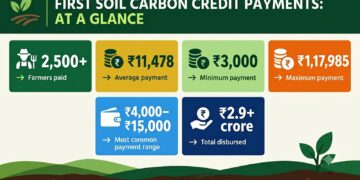
    India Begins Soil-Carbon Payments to Farmers, Opening a New Revenue Opportunity for Sustainable Agriculture  **NEW DELHI:** India has begun making payments to farmers linked to verified soil-carbon credits, marking a significant development in the country’s efforts to connect sustainable farming practices with emerging carbon markets.  More than **2,500 farmers across Punjab and Haryana** are receiving payments associated with measured improvements in soil carbon, according to reports on the initiative. The development offers a new potential source of income for farmers while encouraging agricultural practices aimed at improving soil health and reducing greenhouse-gas emissions.  The initiative comes as agriculture faces growing pressure to increase productivity while protecting natural resources. Continuous cultivation, excessive tillage, inefficient fertiliser use and declining soil organic matter can affect soil quality over time. Carbon-focused farming practices seek to address some of these challenges by increasing the amount of carbon stored in agricultural soils.  ## What Are Soil-Carbon Credits?  Soil-carbon credits are linked to the amount of carbon that agricultural practices can help remove from the atmosphere or retain in soil.  Farmers can potentially generate credits by adopting practices that increase soil organic carbon or reduce emissions. Depending on the methodology used, these practices can include **reduced or zero tillage, improved residue management, cover crops, crop diversification, efficient fertiliser use and other regenerative farming techniques**.  Credits are generally based on measured or verified changes rather than simply on whether a farmer has adopted a particular practice.  This distinction is important because carbon markets require evidence that claimed emissions reductions or carbon storage have actually occurred.  ## Creating an Additional Income Stream  For farmers, the most significant feature of carbon farming is the possibility of receiving income beyond conventional crop sales.  Agricultural revenue can fluctuate considerably because of weather, input prices, crop prices and market conditions. Payments associated with verified environmental outcomes could potentially provide farmers with an additional source of income.  The emerging model links a farmer’s land-management decisions with demand from organisations seeking to account for or compensate for greenhouse-gas emissions.  If carbon markets continue to develop, farmers who adopt suitable practices could potentially earn additional payments while also improving the long-term condition of their soil.  ## Why Soil Health Matters  Soil is one of agriculture’s most important natural resources.  Healthy soils contain organic matter that supports soil structure, water retention and biological activity. Increasing soil organic carbon can contribute to improved soil quality, although the effects depend on local conditions, crop systems and management practices.  Improved soil structure can potentially help fields retain water and withstand periods of moisture stress.  For Indian agriculture, this is particularly relevant as farmers in many regions face increasing pressure from irregular rainfall and water availability.  Better soil management can therefore have benefits that extend beyond carbon accounting.  ## Farmers and Regenerative Agriculture  The growth of soil-carbon programmes is also encouraging greater interest in **regenerative and climate-smart agriculture**.  These approaches generally focus on improving soil health while maintaining or increasing agricultural productivity.  Practices such as reduced tillage can limit soil disturbance. Keeping crop residues in fields can return organic material to the soil. Cover crops can protect soil between production cycles, while crop diversification can support soil biological activity.  However, no single practice is suitable for every farm.  Farmers need to consider local soil characteristics, water availability, crop requirements, machinery, labour and economics before changing their production systems.  ## Measuring Carbon Is a Critical Step  One of the biggest challenges in soil-carbon markets is determining how much carbon has actually been stored.  Unlike a manufactured product, soil carbon can change over time because of weather, cultivation and biological processes.  Carbon-credit programmes therefore need systems for **measurement, reporting and verification**.  Soil samples, field records, remote sensing, modelling and other monitoring methods can be combined to estimate changes in soil carbon.  Reliable verification is essential because buyers of carbon credits need confidence that the environmental benefit represented by a credit is real.  For farmers, accurate measurement is equally important because payments depend on the amount of verified carbon benefits attributed to their land.  ## The Importance of Long-Term Monitoring  Soil-carbon storage is not necessarily permanent.  Carbon levels can decline if land-management practices are reversed. For example, a farmer who moves toward reduced tillage and improved residue management may increase soil carbon over time, but changes in future farming practices could affect those gains.  This means carbon programmes need long-term monitoring rather than relying only on a one-time measurement.  Clear rules around monitoring, verification and the duration of carbon storage will be important as India’s agricultural carbon market develops.  ## Punjab and Haryana at the Centre of the Initiative  Punjab and Haryana have particular significance in India’s agricultural landscape.  The two states are major contributors to the country’s food production, particularly through intensive cereal-based farming systems.  At the same time, intensive agriculture has created concerns around soil health, water use and crop-residue management.  This makes the region an important testing ground for approaches that attempt to combine farm productivity with environmental improvements.  If carbon-linked payments prove economically viable, they could provide farmers with an additional incentive to experiment with improved soil-management practices.  ## Carbon Markets and Indian Agriculture  The emergence of agricultural carbon credits reflects the broader development of India’s carbon-market ecosystem.  Carbon markets are designed to create an economic value for emissions reductions or carbon removal. Companies and other organisations may purchase credits depending on regulatory requirements, voluntary commitments or other market mechanisms.  Agriculture represents a potentially large area of opportunity because soils, vegetation and agricultural practices interact directly with the carbon cycle.  However, agricultural carbon markets are still developing, and their long-term impact will depend on the quality of crediting methodologies, market demand and the costs associated with monitoring and verification.  ## Technology Could Lower the Cost of Participation  Digital technologies could play an increasingly important role in expanding soil-carbon programmes.  Satellite imagery can help monitor agricultural land, while digital farm records can provide information about crop rotations and field practices. Soil sensors and improved sampling techniques can provide additional data.  Artificial intelligence and machine-learning models may also help analyse large quantities of agricultural and environmental information.  The use of technology could eventually reduce the cost of measuring and verifying carbon outcomes, making smaller farms more practical participants in carbon markets.  ## Making Carbon Farming Accessible to Small Farmers  India’s agricultural landscape is dominated by small and marginal farmers, which means that accessibility will be critical.  If carbon-credit programmes involve expensive testing, complicated contracts or high administrative costs, smaller farmers may struggle to participate.  Programmes that aggregate farmers across multiple villages or regions could potentially reduce these costs.  Farmer-producer organisations, cooperatives and other agricultural institutions could also play a role by helping farmers understand carbon programmes, coordinate participation and access technical assistance.

    India Begins Soil-Carbon Payments to Farmers, Opening a New Revenue Opportunity for Sustainable Agriculture **NEW DELHI:** India has begun making payments to farmers linked to verified soil-carbon credits, marking a significant development in the country’s efforts to connect sustainable farming practices with emerging carbon markets. More than **2,500 farmers across Punjab and Haryana** are receiving payments associated with measured improvements in soil carbon, according to reports on the initiative. The development offers a new potential source of income for farmers while encouraging agricultural practices aimed at improving soil health and reducing greenhouse-gas emissions. The initiative comes as agriculture faces growing pressure to increase productivity while protecting natural resources. Continuous cultivation, excessive tillage, inefficient fertiliser use and declining soil organic matter can affect soil quality over time. Carbon-focused farming practices seek to address some of these challenges by increasing the amount of carbon stored in agricultural soils. ## What Are Soil-Carbon Credits? Soil-carbon credits are linked to the amount of carbon that agricultural practices can help remove from the atmosphere or retain in soil. Farmers can potentially generate credits by adopting practices that increase soil organic carbon or reduce emissions. Depending on the methodology used, these practices can include **reduced or zero tillage, improved residue management, cover crops, crop diversification, efficient fertiliser use and other regenerative farming techniques**. Credits are generally based on measured or verified changes rather than simply on whether a farmer has adopted a particular practice. This distinction is important because carbon markets require evidence that claimed emissions reductions or carbon storage have actually occurred. ## Creating an Additional Income Stream For farmers, the most significant feature of carbon farming is the possibility of receiving income beyond conventional crop sales. Agricultural revenue can fluctuate considerably because of weather, input prices, crop prices and market conditions. Payments associated with verified environmental outcomes could potentially provide farmers with an additional source of income. The emerging model links a farmer’s land-management decisions with demand from organisations seeking to account for or compensate for greenhouse-gas emissions. If carbon markets continue to develop, farmers who adopt suitable practices could potentially earn additional payments while also improving the long-term condition of their soil. ## Why Soil Health Matters Soil is one of agriculture’s most important natural resources. Healthy soils contain organic matter that supports soil structure, water retention and biological activity. Increasing soil organic carbon can contribute to improved soil quality, although the effects depend on local conditions, crop systems and management practices. Improved soil structure can potentially help fields retain water and withstand periods of moisture stress. For Indian agriculture, this is particularly relevant as farmers in many regions face increasing pressure from irregular rainfall and water availability. Better soil management can therefore have benefits that extend beyond carbon accounting. ## Farmers and Regenerative Agriculture The growth of soil-carbon programmes is also encouraging greater interest in **regenerative and climate-smart agriculture**. These approaches generally focus on improving soil health while maintaining or increasing agricultural productivity. Practices such as reduced tillage can limit soil disturbance. Keeping crop residues in fields can return organic material to the soil. Cover crops can protect soil between production cycles, while crop diversification can support soil biological activity. However, no single practice is suitable for every farm. Farmers need to consider local soil characteristics, water availability, crop requirements, machinery, labour and economics before changing their production systems. ## Measuring Carbon Is a Critical Step One of the biggest challenges in soil-carbon markets is determining how much carbon has actually been stored. Unlike a manufactured product, soil carbon can change over time because of weather, cultivation and biological processes. Carbon-credit programmes therefore need systems for **measurement, reporting and verification**. Soil samples, field records, remote sensing, modelling and other monitoring methods can be combined to estimate changes in soil carbon. Reliable verification is essential because buyers of carbon credits need confidence that the environmental benefit represented by a credit is real. For farmers, accurate measurement is equally important because payments depend on the amount of verified carbon benefits attributed to their land. ## The Importance of Long-Term Monitoring Soil-carbon storage is not necessarily permanent. Carbon levels can decline if land-management practices are reversed. For example, a farmer who moves toward reduced tillage and improved residue management may increase soil carbon over time, but changes in future farming practices could affect those gains. This means carbon programmes need long-term monitoring rather than relying only on a one-time measurement. Clear rules around monitoring, verification and the duration of carbon storage will be important as India’s agricultural carbon market develops. ## Punjab and Haryana at the Centre of the Initiative Punjab and Haryana have particular significance in India’s agricultural landscape. The two states are major contributors to the country’s food production, particularly through intensive cereal-based farming systems. At the same time, intensive agriculture has created concerns around soil health, water use and crop-residue management. This makes the region an important testing ground for approaches that attempt to combine farm productivity with environmental improvements. If carbon-linked payments prove economically viable, they could provide farmers with an additional incentive to experiment with improved soil-management practices. ## Carbon Markets and Indian Agriculture The emergence of agricultural carbon credits reflects the broader development of India’s carbon-market ecosystem. Carbon markets are designed to create an economic value for emissions reductions or carbon removal. Companies and other organisations may purchase credits depending on regulatory requirements, voluntary commitments or other market mechanisms. Agriculture represents a potentially large area of opportunity because soils, vegetation and agricultural practices interact directly with the carbon cycle. However, agricultural carbon markets are still developing, and their long-term impact will depend on the quality of crediting methodologies, market demand and the costs associated with monitoring and verification. ## Technology Could Lower the Cost of Participation Digital technologies could play an increasingly important role in expanding soil-carbon programmes. Satellite imagery can help monitor agricultural land, while digital farm records can provide information about crop rotations and field practices. Soil sensors and improved sampling techniques can provide additional data. Artificial intelligence and machine-learning models may also help analyse large quantities of agricultural and environmental information. The use of technology could eventually reduce the cost of measuring and verifying carbon outcomes, making smaller farms more practical participants in carbon markets. ## Making Carbon Farming Accessible to Small Farmers India’s agricultural landscape is dominated by small and marginal farmers, which means that accessibility will be critical. If carbon-credit programmes involve expensive testing, complicated contracts or high administrative costs, smaller farmers may struggle to participate. Programmes that aggregate farmers across multiple villages or regions could potentially reduce these costs. Farmer-producer organisations, cooperatives and other agricultural institutions could also play a role by helping farmers understand carbon programmes, coordinate participation and access technical assistance.

    BRICS New Delhi Summit Puts Focus on Agro-Ecology, Digital and Climate-Resilient Agriculture

    BRICS New Delhi Summit Puts Focus on Agro-Ecology, Digital and Climate-Resilient Agriculture

    PI Industries Introduces CARVINT, a Next-Generation Insecticide for Advanced Pest Management in India

    PI Industries Introduces CARVINT, a Next-Generation Insecticide for Advanced Pest Management in India

    New Holland’s ‘Super Safar’: A Customer-Led Journey Through Haryana and Punjab

    New Holland’s ‘Super Safar’: A Customer-Led Journey Through Haryana and Punjab

    Manipal University Jaipur Launches International Innovation Challenge IIC 3.0

    Manipal University Jaipur Launches International Innovation Challenge IIC 3.0

  • Farmers
    Shivraj Singh Chouhan Highlights PM-KISAN Milestone in Patna: Empowering India’s Farmers

    Shivraj Singh Chouhan Highlights PM-KISAN Milestone in Patna: Empowering India’s Farmers

    Gau Sampurna: Revolutionizing Livestock Management for India’s Farmers

    Gau Sampurna: Revolutionizing Livestock Management for India’s Farmers

    VK Packwell: Transforming Indian Agriculture with Affordable & Innovative Irrigation Solutions

    VK Packwell: Transforming Indian Agriculture with Affordable & Innovative Irrigation Solutions

    India has three cropping seasons -- summer, kharif, and rabi.

    India’s kharif crop planting area rises; paddy leading year-on-year

    Robust rains accelerate rice planting in India

    Robust rains accelerate rice planting in India

    Govt says crop insurance claims worth Rs 2,761.10 cr pending under PMFBY till 2021-22

    Govt says crop insurance claims worth Rs 2,761.10 cr pending under PMFBY till 2021-22

    India's rice planting gathers pace as monsoon rains revive

    India’s rice planting gathers pace as monsoon rains revive

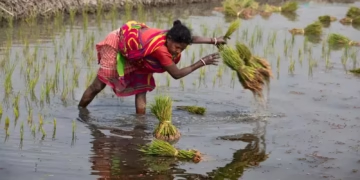
    Farm labourers plant rice saplings in a field on the outskirts of Ahmedabad, India, July 21, 2023. REUTER

    Rice planting gathers pace as monsoon rains revive

  • technology
    New Holland’s ‘Super Safar’: A Customer-Led Journey Through Haryana and Punjab

    New Holland’s ‘Super Safar’: A Customer-Led Journey Through Haryana and Punjab

    Indian Car Makers Plan Major Manufacturing Expansion After Record Gst-Driven Sales

    Indian Car Makers Plan Major Manufacturing Expansion After Record Gst-Driven Sales

    AI for Bharat: Revolutionizing Agriculture, Healthcare, and Education

    AI for Bharat: Revolutionizing Agriculture, Healthcare, and Education

    Driving Transparency: KOLTIVA Leads Sustainable Agribusiness Innovation at Agri Vietnam 2025

    Driving Transparency: KOLTIVA Leads Sustainable Agribusiness Innovation at Agri Vietnam 2025

    AI Leadership: A New Era of Innovation in Information Management

    AI Leadership: A New Era of Innovation in Information Management

    Prime Minister Sets Out AI Action Plan At UCL

    Prime Minister Sets Out AI Action Plan At UCL

    COLINES Innovative Cast MOPE Film for Printing on Show at DRUPA Event

    COLINES Innovative Cast MOPE Film for Printing on Show at DRUPA Event

    Ola Cloud Migration: Shifting IT Workload From AWS After Exiting Microsoft Azure

    Ola Cloud Migration: Shifting IT Workload From AWS After Exiting Microsoft Azure

  • Research
    HarvestPlus and Odisha University of Agriculture and Technology Join Forces to Accelerate Biofortification Research in India

    HarvestPlus and Odisha University of Agriculture and Technology Join Forces to Accelerate Biofortification Research in India

    There are four priority areas on which focused discussions will take place: food security and nutrition, sustainable agriculture through approaches of climate resilient agriculture, digitisation for agricultural transformation and public-private partnerships for research and development in the sector, an official said

    G20 MACS to focus on sustainable agriculture, food security

    Growth dips, public investment stagnant in agriculture sector

    Growth dips, public investment stagnant in agriculture sector

    State requires an outlook report to remove uncertainty in agriculture: CM

    State requires an outlook report to remove uncertainty in agriculture: CM

    Crop waste cattle feed solution ‘averts toxic fires’

    Crop waste cattle feed solution ‘averts toxic fires’

    There is need to intensify agricultural research: Minister

    There is need to intensify agricultural research: Minister

  • Economy
    India to host World Coffee Conference for first time in September

    India to host World Coffee Conference for first time in September

    India's agriculture and food inflation face challenges from erratic rains and El Nino

    India’s agriculture and food inflation face challenges from erratic rains and El Nino

    Explained: How D2C Organic Farming Is Also Empowering Local Communities

    Explained: How D2C Organic Farming Is Also Empowering Local Communities

    India can become sustainable fuel hub by using agri waste: Honeywell

    India can become sustainable fuel hub by using agri waste: Honeywell

    Sahakar Se Samriddhi: 2,500 Kisan Drones To Be Procured By IFFCO For Sustainable Agriculture

    Sahakar Se Samriddhi: 2,500 Kisan Drones To Be Procured By IFFCO For Sustainable Agriculture

    Small dairy farmers: The backbone of Indian dairy

    Small dairy farmers: The backbone of Indian dairy

    Farmers face various challenges while transitioning to organic/natural farming, including a lack of knowledge, non-availability of quality organic and bio-inputs, as well as a lack of market support to get fair and remunerative prices.

    Union Budget 2023-24: India’s farmers can take to organic agriculture with proper support

    Challenges faced by farmers due to climate change have further exacerbated the food insecurity situation across India

    Opinion | From Crop Failure to Food Security: How Climate Change Affects Farmers and Communities

  • India
    New Holland’s ‘Super Safar’: A Customer-Led Journey Through Haryana and Punjab

    New Holland’s ‘Super Safar’: A Customer-Led Journey Through Haryana and Punjab

    Manipal University Jaipur Launches International Innovation Challenge IIC 3.0

    Manipal University Jaipur Launches International Innovation Challenge IIC 3.0

    Ethereal Machines Raises US$13 Million to Boost Advanced Manufacturing in India

    Ethereal Machines Raises US$13 Million to Boost Advanced Manufacturing in India

    10th Ecowaste Exhibition & Forum To Create Blueprint For Addressing Region’s Waste Challenges

    10th Ecowaste Exhibition & Forum To Create Blueprint For Addressing Region’s Waste Challenges

    Pakka Limited and Brawny Bear Join Hands to Launch India’s First Compostable  Flexible Packaging

    Pakka Limited and Brawny Bear Join Hands to Launch India’s First Compostable Flexible Packaging

    SIG lays Foundation of its First Indian Aseptic Carton plant in Ahmedabad

    SIG lays Foundation of its First Indian Aseptic Carton plant in Ahmedabad

    VK Packwell: Transforming Indian Agriculture with Affordable & Innovative Irrigation Solutions

    VK Packwell: Transforming Indian Agriculture with Affordable & Innovative Irrigation Solutions

    Climate Change Leading to Erratic Agriculture in India

    Climate Change Leading to Erratic Agriculture in India

    India’s G20 Presidency Highlights Food Safety Net Programmes, Says Agriculture Ministry

    India’s G20 Presidency Highlights Food Safety Net Programmes, Says Agriculture Ministry

    • Rural
      Impact of Startups on Indian Agriculture and Rural Growth

      Impact of Startups on Indian Agriculture and Rural Growth

      Sahakar Se Samriddhi: 2,500 Kisan Drones To Be Procured By IFFCO For Sustainable Agriculture

      Sahakar Se Samriddhi: 2,500 Kisan Drones To Be Procured By IFFCO For Sustainable Agriculture

      Pioneering Pigeonpea Project Unveiled in India

      Pioneering Pigeonpea Project Unveiled in India

      Crop waste cattle feed solution ‘averts toxic fires’

      Crop waste cattle feed solution ‘averts toxic fires’

      Promoting Inclusive Business in Agriculture and Food Systems in India

      Promoting Inclusive Business in Agriculture and Food Systems in India

      Agri finance company Kissandhan eyes 15% of Farmers Producer Organisation business, signs up four FPOs in West Bengal

      Agri finance company Kissandhan eyes 15% of Farmers Producer Organisation business, signs up four FPOs in West Bengal

      Agro Tech 2022: Rural farmers bat for technology in agriculture

      Agro Tech 2022: Rural farmers bat for technology in agriculture

    • Startup
      Karsan’s 100% Electric Autonomous e-JEST  Hits the Roads in America

      Karsan’s 100% Electric Autonomous e-JEST Hits the Roads in America

      65 Startups Named to MedTech Innovator 2024 Cohort

      65 Startups Named to MedTech Innovator 2024 Cohort

      Yatra Unveils AI-Powered Tool to Help Smes, Large Enterprises Manage Expenses Efficiently

      Yatra Unveils AI-Powered Tool to Help Smes, Large Enterprises Manage Expenses Efficiently

      Vietnam Education Startup Prep Bags US$7 Million in Series A Funding

      Vietnam Education Startup Prep Bags US$7 Million in Series A Funding

      ’80-100 Hours a Week, No WFH’: Sachin Bansal on Building Fintech Startup Navi After Flipkart

      ’80-100 Hours a Week, No WFH’: Sachin Bansal on Building Fintech Startup Navi After Flipkart

      ‘Never had a Funding Winter… Good Firms Always had Enough Money to Back Them’: Sanjeev Bikhchandani

      ‘Never had a Funding Winter… Good Firms Always had Enough Money to Back Them’: Sanjeev Bikhchandani

      Amazon Invests US$2.75 Billion in AI Startup Anthropic

      Amazon Invests US$2.75 Billion in AI Startup Anthropic

      Agriculture Accelerator Fund To Encourage Startups: Finance Minister

      Agriculture Accelerator Fund To Encourage Startups: Finance Minister

      The agriculture budget has increased

      The agriculture budget has increased; we have now over 3,000 agri startups: PM Modi

  • Home
  • News
    Transforming Manufacturing: TAGMA’s Next-Gen Tooling Showcase at 2026 Expo

    Transforming Manufacturing: TAGMA’s Next-Gen Tooling Showcase at 2026 Expo

    Texas Agriculture Issues Urgent Alert As Invasive Pest Detected In Multiple Counties, Including Houston Area

    Texas Agriculture Issues Urgent Alert As Invasive Pest Detected In Multiple Counties, Including Houston Area

    USDA Launches New Regenerative Pilot Program To Lower Farmer Production Costs And Advance MAHA Agenda

    USDA Launches New Regenerative Pilot Program To Lower Farmer Production Costs And Advance MAHA Agenda

    Shibu Jose Joins Global Council Of The World Agriculture Forum (WAF)

    Shibu Jose Joins Global Council Of The World Agriculture Forum (WAF)

    India’s First Edible Oil Consumption Survey Underway

    India’s First Edible Oil Consumption Survey Underway

    Prime Minister Sets Out AI Action Plan At UCL

    Prime Minister Sets Out AI Action Plan At UCL

    UAE To Develop Lander For Emirates Asteroid Belt Mission

    UAE To Develop Lander For Emirates Asteroid Belt Mission

    US To Have Unlimited Access To Al Chips

    US To Have Unlimited Access To Al Chips

  • Agriculture
    South India Agriculture Conference Pushes Digital Farming, Precision Agriculture and Climate-Resilient Agriculture

    South India Agriculture Conference Pushes Digital Farming, Precision Agriculture and Climate-Resilient Agriculture

    Uneven Monsoon Raises Concerns Over India’s Kharif Crop Output as Harvest Season Nears

    Uneven Monsoon Raises Concerns Over India’s Kharif Crop Output as Harvest Season Nears

    FAO Calls for Better Climate Finance to Strengthen Global Agrifood Systems

    FAO Calls for Better Climate Finance to Strengthen Global Agrifood Systems

    India Begins Soil-Carbon Payments to Farmers, Opening a New Revenue Opportunity for Sustainable Agriculture  **NEW DELHI:** India has begun making payments to farmers linked to verified soil-carbon credits, marking a significant development in the country’s efforts to connect sustainable farming practices with emerging carbon markets.  More than **2,500 farmers across Punjab and Haryana** are receiving payments associated with measured improvements in soil carbon, according to reports on the initiative. The development offers a new potential source of income for farmers while encouraging agricultural practices aimed at improving soil health and reducing greenhouse-gas emissions.  The initiative comes as agriculture faces growing pressure to increase productivity while protecting natural resources. Continuous cultivation, excessive tillage, inefficient fertiliser use and declining soil organic matter can affect soil quality over time. Carbon-focused farming practices seek to address some of these challenges by increasing the amount of carbon stored in agricultural soils.  ## What Are Soil-Carbon Credits?  Soil-carbon credits are linked to the amount of carbon that agricultural practices can help remove from the atmosphere or retain in soil.  Farmers can potentially generate credits by adopting practices that increase soil organic carbon or reduce emissions. Depending on the methodology used, these practices can include **reduced or zero tillage, improved residue management, cover crops, crop diversification, efficient fertiliser use and other regenerative farming techniques**.  Credits are generally based on measured or verified changes rather than simply on whether a farmer has adopted a particular practice.  This distinction is important because carbon markets require evidence that claimed emissions reductions or carbon storage have actually occurred.  ## Creating an Additional Income Stream  For farmers, the most significant feature of carbon farming is the possibility of receiving income beyond conventional crop sales.  Agricultural revenue can fluctuate considerably because of weather, input prices, crop prices and market conditions. Payments associated with verified environmental outcomes could potentially provide farmers with an additional source of income.  The emerging model links a farmer’s land-management decisions with demand from organisations seeking to account for or compensate for greenhouse-gas emissions.  If carbon markets continue to develop, farmers who adopt suitable practices could potentially earn additional payments while also improving the long-term condition of their soil.  ## Why Soil Health Matters  Soil is one of agriculture’s most important natural resources.  Healthy soils contain organic matter that supports soil structure, water retention and biological activity. Increasing soil organic carbon can contribute to improved soil quality, although the effects depend on local conditions, crop systems and management practices.  Improved soil structure can potentially help fields retain water and withstand periods of moisture stress.  For Indian agriculture, this is particularly relevant as farmers in many regions face increasing pressure from irregular rainfall and water availability.  Better soil management can therefore have benefits that extend beyond carbon accounting.  ## Farmers and Regenerative Agriculture  The growth of soil-carbon programmes is also encouraging greater interest in **regenerative and climate-smart agriculture**.  These approaches generally focus on improving soil health while maintaining or increasing agricultural productivity.  Practices such as reduced tillage can limit soil disturbance. Keeping crop residues in fields can return organic material to the soil. Cover crops can protect soil between production cycles, while crop diversification can support soil biological activity.  However, no single practice is suitable for every farm.  Farmers need to consider local soil characteristics, water availability, crop requirements, machinery, labour and economics before changing their production systems.  ## Measuring Carbon Is a Critical Step  One of the biggest challenges in soil-carbon markets is determining how much carbon has actually been stored.  Unlike a manufactured product, soil carbon can change over time because of weather, cultivation and biological processes.  Carbon-credit programmes therefore need systems for **measurement, reporting and verification**.  Soil samples, field records, remote sensing, modelling and other monitoring methods can be combined to estimate changes in soil carbon.  Reliable verification is essential because buyers of carbon credits need confidence that the environmental benefit represented by a credit is real.  For farmers, accurate measurement is equally important because payments depend on the amount of verified carbon benefits attributed to their land.  ## The Importance of Long-Term Monitoring  Soil-carbon storage is not necessarily permanent.  Carbon levels can decline if land-management practices are reversed. For example, a farmer who moves toward reduced tillage and improved residue management may increase soil carbon over time, but changes in future farming practices could affect those gains.  This means carbon programmes need long-term monitoring rather than relying only on a one-time measurement.  Clear rules around monitoring, verification and the duration of carbon storage will be important as India’s agricultural carbon market develops.  ## Punjab and Haryana at the Centre of the Initiative  Punjab and Haryana have particular significance in India’s agricultural landscape.  The two states are major contributors to the country’s food production, particularly through intensive cereal-based farming systems.  At the same time, intensive agriculture has created concerns around soil health, water use and crop-residue management.  This makes the region an important testing ground for approaches that attempt to combine farm productivity with environmental improvements.  If carbon-linked payments prove economically viable, they could provide farmers with an additional incentive to experiment with improved soil-management practices.  ## Carbon Markets and Indian Agriculture  The emergence of agricultural carbon credits reflects the broader development of India’s carbon-market ecosystem.  Carbon markets are designed to create an economic value for emissions reductions or carbon removal. Companies and other organisations may purchase credits depending on regulatory requirements, voluntary commitments or other market mechanisms.  Agriculture represents a potentially large area of opportunity because soils, vegetation and agricultural practices interact directly with the carbon cycle.  However, agricultural carbon markets are still developing, and their long-term impact will depend on the quality of crediting methodologies, market demand and the costs associated with monitoring and verification.  ## Technology Could Lower the Cost of Participation  Digital technologies could play an increasingly important role in expanding soil-carbon programmes.  Satellite imagery can help monitor agricultural land, while digital farm records can provide information about crop rotations and field practices. Soil sensors and improved sampling techniques can provide additional data.  Artificial intelligence and machine-learning models may also help analyse large quantities of agricultural and environmental information.  The use of technology could eventually reduce the cost of measuring and verifying carbon outcomes, making smaller farms more practical participants in carbon markets.  ## Making Carbon Farming Accessible to Small Farmers  India’s agricultural landscape is dominated by small and marginal farmers, which means that accessibility will be critical.  If carbon-credit programmes involve expensive testing, complicated contracts or high administrative costs, smaller farmers may struggle to participate.  Programmes that aggregate farmers across multiple villages or regions could potentially reduce these costs.  Farmer-producer organisations, cooperatives and other agricultural institutions could also play a role by helping farmers understand carbon programmes, coordinate participation and access technical assistance.

    India Begins Soil-Carbon Payments to Farmers, Opening a New Revenue Opportunity for Sustainable Agriculture **NEW DELHI:** India has begun making payments to farmers linked to verified soil-carbon credits, marking a significant development in the country’s efforts to connect sustainable farming practices with emerging carbon markets. More than **2,500 farmers across Punjab and Haryana** are receiving payments associated with measured improvements in soil carbon, according to reports on the initiative. The development offers a new potential source of income for farmers while encouraging agricultural practices aimed at improving soil health and reducing greenhouse-gas emissions. The initiative comes as agriculture faces growing pressure to increase productivity while protecting natural resources. Continuous cultivation, excessive tillage, inefficient fertiliser use and declining soil organic matter can affect soil quality over time. Carbon-focused farming practices seek to address some of these challenges by increasing the amount of carbon stored in agricultural soils. ## What Are Soil-Carbon Credits? Soil-carbon credits are linked to the amount of carbon that agricultural practices can help remove from the atmosphere or retain in soil. Farmers can potentially generate credits by adopting practices that increase soil organic carbon or reduce emissions. Depending on the methodology used, these practices can include **reduced or zero tillage, improved residue management, cover crops, crop diversification, efficient fertiliser use and other regenerative farming techniques**. Credits are generally based on measured or verified changes rather than simply on whether a farmer has adopted a particular practice. This distinction is important because carbon markets require evidence that claimed emissions reductions or carbon storage have actually occurred. ## Creating an Additional Income Stream For farmers, the most significant feature of carbon farming is the possibility of receiving income beyond conventional crop sales. Agricultural revenue can fluctuate considerably because of weather, input prices, crop prices and market conditions. Payments associated with verified environmental outcomes could potentially provide farmers with an additional source of income. The emerging model links a farmer’s land-management decisions with demand from organisations seeking to account for or compensate for greenhouse-gas emissions. If carbon markets continue to develop, farmers who adopt suitable practices could potentially earn additional payments while also improving the long-term condition of their soil. ## Why Soil Health Matters Soil is one of agriculture’s most important natural resources. Healthy soils contain organic matter that supports soil structure, water retention and biological activity. Increasing soil organic carbon can contribute to improved soil quality, although the effects depend on local conditions, crop systems and management practices. Improved soil structure can potentially help fields retain water and withstand periods of moisture stress. For Indian agriculture, this is particularly relevant as farmers in many regions face increasing pressure from irregular rainfall and water availability. Better soil management can therefore have benefits that extend beyond carbon accounting. ## Farmers and Regenerative Agriculture The growth of soil-carbon programmes is also encouraging greater interest in **regenerative and climate-smart agriculture**. These approaches generally focus on improving soil health while maintaining or increasing agricultural productivity. Practices such as reduced tillage can limit soil disturbance. Keeping crop residues in fields can return organic material to the soil. Cover crops can protect soil between production cycles, while crop diversification can support soil biological activity. However, no single practice is suitable for every farm. Farmers need to consider local soil characteristics, water availability, crop requirements, machinery, labour and economics before changing their production systems. ## Measuring Carbon Is a Critical Step One of the biggest challenges in soil-carbon markets is determining how much carbon has actually been stored. Unlike a manufactured product, soil carbon can change over time because of weather, cultivation and biological processes. Carbon-credit programmes therefore need systems for **measurement, reporting and verification**. Soil samples, field records, remote sensing, modelling and other monitoring methods can be combined to estimate changes in soil carbon. Reliable verification is essential because buyers of carbon credits need confidence that the environmental benefit represented by a credit is real. For farmers, accurate measurement is equally important because payments depend on the amount of verified carbon benefits attributed to their land. ## The Importance of Long-Term Monitoring Soil-carbon storage is not necessarily permanent. Carbon levels can decline if land-management practices are reversed. For example, a farmer who moves toward reduced tillage and improved residue management may increase soil carbon over time, but changes in future farming practices could affect those gains. This means carbon programmes need long-term monitoring rather than relying only on a one-time measurement. Clear rules around monitoring, verification and the duration of carbon storage will be important as India’s agricultural carbon market develops. ## Punjab and Haryana at the Centre of the Initiative Punjab and Haryana have particular significance in India’s agricultural landscape. The two states are major contributors to the country’s food production, particularly through intensive cereal-based farming systems. At the same time, intensive agriculture has created concerns around soil health, water use and crop-residue management. This makes the region an important testing ground for approaches that attempt to combine farm productivity with environmental improvements. If carbon-linked payments prove economically viable, they could provide farmers with an additional incentive to experiment with improved soil-management practices. ## Carbon Markets and Indian Agriculture The emergence of agricultural carbon credits reflects the broader development of India’s carbon-market ecosystem. Carbon markets are designed to create an economic value for emissions reductions or carbon removal. Companies and other organisations may purchase credits depending on regulatory requirements, voluntary commitments or other market mechanisms. Agriculture represents a potentially large area of opportunity because soils, vegetation and agricultural practices interact directly with the carbon cycle. However, agricultural carbon markets are still developing, and their long-term impact will depend on the quality of crediting methodologies, market demand and the costs associated with monitoring and verification. ## Technology Could Lower the Cost of Participation Digital technologies could play an increasingly important role in expanding soil-carbon programmes. Satellite imagery can help monitor agricultural land, while digital farm records can provide information about crop rotations and field practices. Soil sensors and improved sampling techniques can provide additional data. Artificial intelligence and machine-learning models may also help analyse large quantities of agricultural and environmental information. The use of technology could eventually reduce the cost of measuring and verifying carbon outcomes, making smaller farms more practical participants in carbon markets. ## Making Carbon Farming Accessible to Small Farmers India’s agricultural landscape is dominated by small and marginal farmers, which means that accessibility will be critical. If carbon-credit programmes involve expensive testing, complicated contracts or high administrative costs, smaller farmers may struggle to participate. Programmes that aggregate farmers across multiple villages or regions could potentially reduce these costs. Farmer-producer organisations, cooperatives and other agricultural institutions could also play a role by helping farmers understand carbon programmes, coordinate participation and access technical assistance.

    BRICS New Delhi Summit Puts Focus on Agro-Ecology, Digital and Climate-Resilient Agriculture

    BRICS New Delhi Summit Puts Focus on Agro-Ecology, Digital and Climate-Resilient Agriculture

    PI Industries Introduces CARVINT, a Next-Generation Insecticide for Advanced Pest Management in India

    PI Industries Introduces CARVINT, a Next-Generation Insecticide for Advanced Pest Management in India

    New Holland’s ‘Super Safar’: A Customer-Led Journey Through Haryana and Punjab

    New Holland’s ‘Super Safar’: A Customer-Led Journey Through Haryana and Punjab

    Manipal University Jaipur Launches International Innovation Challenge IIC 3.0

    Manipal University Jaipur Launches International Innovation Challenge IIC 3.0

  • Farmers
    Shivraj Singh Chouhan Highlights PM-KISAN Milestone in Patna: Empowering India’s Farmers

    Shivraj Singh Chouhan Highlights PM-KISAN Milestone in Patna: Empowering India’s Farmers

    Gau Sampurna: Revolutionizing Livestock Management for India’s Farmers

    Gau Sampurna: Revolutionizing Livestock Management for India’s Farmers

    VK Packwell: Transforming Indian Agriculture with Affordable & Innovative Irrigation Solutions

    VK Packwell: Transforming Indian Agriculture with Affordable & Innovative Irrigation Solutions

    India has three cropping seasons -- summer, kharif, and rabi.

    India’s kharif crop planting area rises; paddy leading year-on-year

    Robust rains accelerate rice planting in India

    Robust rains accelerate rice planting in India

    Govt says crop insurance claims worth Rs 2,761.10 cr pending under PMFBY till 2021-22

    Govt says crop insurance claims worth Rs 2,761.10 cr pending under PMFBY till 2021-22

    India's rice planting gathers pace as monsoon rains revive

    India’s rice planting gathers pace as monsoon rains revive

    Farm labourers plant rice saplings in a field on the outskirts of Ahmedabad, India, July 21, 2023. REUTER

    Rice planting gathers pace as monsoon rains revive

  • technology
    New Holland’s ‘Super Safar’: A Customer-Led Journey Through Haryana and Punjab

    New Holland’s ‘Super Safar’: A Customer-Led Journey Through Haryana and Punjab

    Indian Car Makers Plan Major Manufacturing Expansion After Record Gst-Driven Sales

    Indian Car Makers Plan Major Manufacturing Expansion After Record Gst-Driven Sales

    AI for Bharat: Revolutionizing Agriculture, Healthcare, and Education

    AI for Bharat: Revolutionizing Agriculture, Healthcare, and Education

    Driving Transparency: KOLTIVA Leads Sustainable Agribusiness Innovation at Agri Vietnam 2025

    Driving Transparency: KOLTIVA Leads Sustainable Agribusiness Innovation at Agri Vietnam 2025

    AI Leadership: A New Era of Innovation in Information Management

    AI Leadership: A New Era of Innovation in Information Management

    Prime Minister Sets Out AI Action Plan At UCL

    Prime Minister Sets Out AI Action Plan At UCL

    COLINES Innovative Cast MOPE Film for Printing on Show at DRUPA Event

    COLINES Innovative Cast MOPE Film for Printing on Show at DRUPA Event

    Ola Cloud Migration: Shifting IT Workload From AWS After Exiting Microsoft Azure

    Ola Cloud Migration: Shifting IT Workload From AWS After Exiting Microsoft Azure

  • Research
    HarvestPlus and Odisha University of Agriculture and Technology Join Forces to Accelerate Biofortification Research in India

    HarvestPlus and Odisha University of Agriculture and Technology Join Forces to Accelerate Biofortification Research in India

    There are four priority areas on which focused discussions will take place: food security and nutrition, sustainable agriculture through approaches of climate resilient agriculture, digitisation for agricultural transformation and public-private partnerships for research and development in the sector, an official said

    G20 MACS to focus on sustainable agriculture, food security

    Growth dips, public investment stagnant in agriculture sector

    Growth dips, public investment stagnant in agriculture sector

    State requires an outlook report to remove uncertainty in agriculture: CM

    State requires an outlook report to remove uncertainty in agriculture: CM

    Crop waste cattle feed solution ‘averts toxic fires’

    Crop waste cattle feed solution ‘averts toxic fires’

    There is need to intensify agricultural research: Minister

    There is need to intensify agricultural research: Minister

  • Economy
    India to host World Coffee Conference for first time in September

    India to host World Coffee Conference for first time in September

    India's agriculture and food inflation face challenges from erratic rains and El Nino

    India’s agriculture and food inflation face challenges from erratic rains and El Nino

    Explained: How D2C Organic Farming Is Also Empowering Local Communities

    Explained: How D2C Organic Farming Is Also Empowering Local Communities

    India can become sustainable fuel hub by using agri waste: Honeywell

    India can become sustainable fuel hub by using agri waste: Honeywell

    Sahakar Se Samriddhi: 2,500 Kisan Drones To Be Procured By IFFCO For Sustainable Agriculture

    Sahakar Se Samriddhi: 2,500 Kisan Drones To Be Procured By IFFCO For Sustainable Agriculture

    Small dairy farmers: The backbone of Indian dairy

    Small dairy farmers: The backbone of Indian dairy

    Farmers face various challenges while transitioning to organic/natural farming, including a lack of knowledge, non-availability of quality organic and bio-inputs, as well as a lack of market support to get fair and remunerative prices.

    Union Budget 2023-24: India’s farmers can take to organic agriculture with proper support

    Challenges faced by farmers due to climate change have further exacerbated the food insecurity situation across India

    Opinion | From Crop Failure to Food Security: How Climate Change Affects Farmers and Communities

  • India
    New Holland’s ‘Super Safar’: A Customer-Led Journey Through Haryana and Punjab

    New Holland’s ‘Super Safar’: A Customer-Led Journey Through Haryana and Punjab

    Manipal University Jaipur Launches International Innovation Challenge IIC 3.0

    Manipal University Jaipur Launches International Innovation Challenge IIC 3.0

    Ethereal Machines Raises US$13 Million to Boost Advanced Manufacturing in India

    Ethereal Machines Raises US$13 Million to Boost Advanced Manufacturing in India

    10th Ecowaste Exhibition & Forum To Create Blueprint For Addressing Region’s Waste Challenges

    10th Ecowaste Exhibition & Forum To Create Blueprint For Addressing Region’s Waste Challenges

    Pakka Limited and Brawny Bear Join Hands to Launch India’s First Compostable  Flexible Packaging

    Pakka Limited and Brawny Bear Join Hands to Launch India’s First Compostable Flexible Packaging

    SIG lays Foundation of its First Indian Aseptic Carton plant in Ahmedabad

    SIG lays Foundation of its First Indian Aseptic Carton plant in Ahmedabad

    VK Packwell: Transforming Indian Agriculture with Affordable & Innovative Irrigation Solutions

    VK Packwell: Transforming Indian Agriculture with Affordable & Innovative Irrigation Solutions

    Climate Change Leading to Erratic Agriculture in India

    Climate Change Leading to Erratic Agriculture in India

    India’s G20 Presidency Highlights Food Safety Net Programmes, Says Agriculture Ministry

    India’s G20 Presidency Highlights Food Safety Net Programmes, Says Agriculture Ministry

    • Rural
      Impact of Startups on Indian Agriculture and Rural Growth

      Impact of Startups on Indian Agriculture and Rural Growth

      Sahakar Se Samriddhi: 2,500 Kisan Drones To Be Procured By IFFCO For Sustainable Agriculture

      Sahakar Se Samriddhi: 2,500 Kisan Drones To Be Procured By IFFCO For Sustainable Agriculture

      Pioneering Pigeonpea Project Unveiled in India

      Pioneering Pigeonpea Project Unveiled in India

      Crop waste cattle feed solution ‘averts toxic fires’

      Crop waste cattle feed solution ‘averts toxic fires’

      Promoting Inclusive Business in Agriculture and Food Systems in India

      Promoting Inclusive Business in Agriculture and Food Systems in India

      Agri finance company Kissandhan eyes 15% of Farmers Producer Organisation business, signs up four FPOs in West Bengal

      Agri finance company Kissandhan eyes 15% of Farmers Producer Organisation business, signs up four FPOs in West Bengal

      Agro Tech 2022: Rural farmers bat for technology in agriculture

      Agro Tech 2022: Rural farmers bat for technology in agriculture

    • Startup
      Karsan’s 100% Electric Autonomous e-JEST  Hits the Roads in America

      Karsan’s 100% Electric Autonomous e-JEST Hits the Roads in America

      65 Startups Named to MedTech Innovator 2024 Cohort

      65 Startups Named to MedTech Innovator 2024 Cohort

      Yatra Unveils AI-Powered Tool to Help Smes, Large Enterprises Manage Expenses Efficiently

      Yatra Unveils AI-Powered Tool to Help Smes, Large Enterprises Manage Expenses Efficiently

      Vietnam Education Startup Prep Bags US$7 Million in Series A Funding

      Vietnam Education Startup Prep Bags US$7 Million in Series A Funding

      ’80-100 Hours a Week, No WFH’: Sachin Bansal on Building Fintech Startup Navi After Flipkart

      ’80-100 Hours a Week, No WFH’: Sachin Bansal on Building Fintech Startup Navi After Flipkart

      ‘Never had a Funding Winter… Good Firms Always had Enough Money to Back Them’: Sanjeev Bikhchandani

      ‘Never had a Funding Winter… Good Firms Always had Enough Money to Back Them’: Sanjeev Bikhchandani

      Amazon Invests US$2.75 Billion in AI Startup Anthropic

      Amazon Invests US$2.75 Billion in AI Startup Anthropic

      Agriculture Accelerator Fund To Encourage Startups: Finance Minister

      Agriculture Accelerator Fund To Encourage Startups: Finance Minister

      The agriculture budget has increased

      The agriculture budget has increased; we have now over 3,000 agri startups: PM Modi

No Result
View All Result
Modern Agriculture India
No Result
View All Result
Home Featured

Cosmo First Launch New Business Division Plastech, Planning New Site in Maharashtra

Junior Editor by Junior Editor
3 years ago
in Featured
0 0
Cosmo First Launch New Business Division Plastech, Planning New Site in Maharashtra

Cosmo First launches Cosmo Plastech

Share on FacebookShare on Twitter
Post Views: 238

Cosmo First Launch New Business Division Plastech, Planning New Site in Maharashtra

Delhi headquartered Cosmo First regarded as global leader in speciality films for packaging, labelling, synthetic paper, and lamination applications announces the launch of its new business division- Cosmo Plastech. This strategic move aligns perfectly with the company’s vision of offering a diverse range of packaging solutions to its valued partners for a wide array of FMCG products, providing enhanced supply chain efficiency.

Established in 1981, Cosmo First (erstwhile Cosmo Films) is an emerging player in specialty chemicals (Masterbatches, Adhesive, & coating) along with a digital-first Omni channel Pet care business under the brand name ‘Zigly’. With engineering of innovative products and sustainability solutions, Cosmo First over the years has been partnering with worlds’ leading F&B and personal care brands and packaging & printing converters to enhance the end consumer experience. Its customer base is spread in more than 100+ countries with sales & manufacturing units in India and Korea and additionally sales & distribution base in Japan, USA, Canada, and Europe.

Pankaj Poddar, Group CEO, Cosmo First Ltd shares fast-growing group’s expansion and investment plans with ‘International Plastics News for Asia’ recently.

What is the strategy behind launching a new business division Cosmo Plastech?

For the past four decades, Cosmo First has proudly pioneered industry-first solutions. As the demand for FMCG items grows, so does the desire for new packaging solutions. With the establishment of Cosmo Plastech, we want to provide cutting-edge rigid packaging solutions to our clients and consumers while maintaining our steadfast commitment to sustainability. The strategic decision to develop Cosmo Plastech is ideally aligned with our aim of delivering a comprehensive variety of packaging solutions and sheets to our valued partners for a wide range of FMCG, electronic, and other industries, hence improving supply chain efficiency. This is a huge step forward in our quest for a greener future since positive changes in the packaging sector pave the way for a circular economy.

Is there any specific hi-end product range to be introduced under the new business division?

Cosmo Plastech looks forward to catering to the industry’s changing expectations in an environmentally conscientious manner. Currently, our packaging containers are made from high-quality materials to ensure durability and reliability using injection moulding and thermoforming techniques. Our expertise in rigid packaging solutions combined with state-of-the-art machinery ensures that the products are moisture-resistant and tamper-proof. This makes the solutions of Cosmo Plastech an alternative to traditional packaging practices. Our containers are round, rectangle, oval square, and many other shapes with special anti-counterfeiting solutions box containers which are the products with most demand. Other Cosmo Plastech’s products are:

  • TF Cups, available for storing beverages, dairy items, ice cream, jams, sauces, etc.
  • TF Trays used for sweets and food packaging.
  • Thinwall for food packaging containers
  • Sheets for freezer grade, antistatic, ESD (Electrostatic discharge), hot film
  • Other electronic industry packaging etc.

Going forward, as per industry demand and expectations, we may look at introducing more products and ranges.

What revenue the new business division expected to add in the next three years?

We are targeting INR 100-150 crores (US$ 12 Mn – 18 Mn) in the next three years.

When did the company rebranded as Cosmo First?

We rebranded from Cosmo Films to Cosmo First in July 2022. The company aspire to be the first choice for all its stakeholders and will strive hard to always stay ahead of the curve to industry-first solutions.

What are the objectives of the rebranding and how it impacted the Cosmo profile in the Indian and international market in positive manner

Over the last few decades, we have established ourselves as the most sought-after global brand for value-added films. The strategic choice to rename stems from our company’s expansion of business operations beyond films into specialty chemicals, coating, adhesive, masterbatches, and D2C Pet care. The rebranding reinforces Cosmo’s value and strengthens our emphasis on creating a better life for people, the globe, and the society we live in, based on trust, empathy, compassion, and our core practice of putting people, employees, and our customers first. Today, we are a four-decade-old Indian corporate conglomerate widely known for our reliance on innovation to create value in a variety of emerging areas such as polymer.  Further, we have also expanded into BOPET, shrink films, and CPP lines, and have introduced new business verticals and products like Cosmo Sunshield (window films) and Cosmo Plastech (rigid packaging).

Share the details of the various sites, location along with production in terms of volumes

Our manufacturing sites in India are in Waluj (Aurangabad), Shendra (Aurangabad), and Karjan (Vadodara). We also have sales and distribution centres in Canada, the US, Korea, Japan, Germany, and the UK.

PRODUCTS EXISTING UPCOMING
BOPP Films 2,00,000 TPA 15,000 TPA
CPP Films 9,000 TPA
Thermal Films 30,000 TPA
Coated Films 20,000 TPA
Metalized Films 30,000 TPA 8000 TPA
Rigid Packaging 10,000 TPA
BOPET 30,000 TPA
CSP 10,000 TPA
PET-G 14,000 TPA
Sheets 4000 TPA 10,000 TPA

Cosmo First has been consistently introducing new products in the film vertical, share details of the products launched recently and in the pipeline in the near future?

We have launched several new specialty films including shrink for packaging and non-packaging applications. A few other specialty films from non-packaging applications are also in the pipeline and should hit the market in the coming quarters. Having commercialised our specialised BOPET line in September 2022, we are in the process of launching several new specialty products including window film, security film, and PET-G film. While our new companies are still in their infant stages, we are increasing our capacity for speciality films. Some of the recent products that we have introduced in the market are susceptor films, scuff free lamination films, polyester-based thermal lamination films, ID card map & match films.

We have successfully developed a new transparent printable biaxially oriented polypropylene (BOPP) film named “TeploR” which has higher heat resistance as compared to conventional BOPP films. The film has been engineered to work as a printing layer replacing BOPET film in multi-layer laminates for various packaging applications in both food and non-food segments. The thermally stable films have excellent slip properties and good machinability and have good performance on high-speed VFFS and HFFS machines. This film has good thermal stability (no shrinkage) upto 185˚ C as compared to conventional BOPP films of 145-155˚ C.

To stimulate expansion in specialty chemicals, we plan to introduce label adhesives, and coating chemicals for our existing B2C customer base this year. Alongside, as part of our product expansion strategy and to cater to industry demands, we have also introduced:

Any new site planned or expansion planned, if yes, share details

Yes, we have our expansion plans for our film business in line. We look forward to commissioning our 10th BOPP line by 2025 & 3rd CPP line by 2024. Further, we are planning one more site in Maharashtra. We will be focussing on our sheets for the rigid packaging business as well.

What is the company turnover in 2022, annual growth rate despite challenging business scenario and growth target for fiscal 2023

The BOPP & BOPET business had an excess supply in FY23 due to the bunching of numerous new manufacturing lines. Although demand continues to rise, the bunching of supply reduced margins and impacted the whole sector. Cosmo First, with more than two-thirds of our sales from specialised films, resisted margin pressure and outperformed the industry substantially.

Our consolidated revenue increased marginally to INR 3,065 crores (USD 368 Mn) in FY’23 from INR 3,038 crores (US$ 364 Mn) in FY’22, after expanding at a CAGR of more than 13.3% from FY18 to FY22 (speciality film sales increased at a CAGR of 18% over three years). Despite a hard economic situation, our EBITDA for the year stood at INR 434 crores (US$ 60.76 Mn) demonstrating the resilience of speciality films. ROCE (Return on Capital Employed) and ROE (Return on Equity) were 16% and 20%, respectively. We are aiming for a top line of roughly INR 5,000 crores (US$ 600 Mn) in the next 3-4 years, with new businesses accounting for 15-20% of sales.

Do Cosmo introduce any new products in the US market?

In the US, we have multiple sales and distribution centres at different locations and carry slitting for local needs. For the products, in the US market, we have introduced the thermal lamination films which is one of our flagship products. We are strategizing for the high-margin films in the US market. All our products are available in the US market.

Comments on the evolving Indian market and how Cosmo aspired to achieve its goals and objectives?

The Indian market has been steadily growing in recent years. The demand for film and packaging solutions has been on the rise, driven by various factors, including increased consumerism, e-commerce expansion, and a growing middle-class population. We have recognised this growth and have strategically positioned ourselves to leverage the opportunities presented by this upward trajectory.

In recent years, India has well positioned itself as a global market hub and Cosmo has emerged as one of the leading players within the Indian market. We have not only catered to domestic demand but also successfully penetrated international markets. Our ability to provide high-quality film and packaging solutions has made us a preferred choice for clients not only in India but also across the world. This expansion reflects our ambition to be a key player in the global supply chain.

Further, with ongoing changes and uncertainties in the China market, many businesses are actively seeking alternatives. We have ensured to keep our supply chains running and stand as a strong and reliable alternative to the Chinese market for our customers. Our commitment to quality, competitive pricing, and a customer-centric approach have attracted businesses looking for dependable sourcing options. This strategic positioning aligns with our long-term goals to become a leading player in the global film and packaging industry.

We plan to raise our entire film capacity by approximately 50% by FY’26, at a cost of around INR 500 crore (USD 70 Mn), and our film income will increase by approximately 50% by FY’27. Our diversification into new industries including specialty chemicals and pet care has progressed as planned. Both segments are growing and contributing to the company’s long-term wealth generation potential. Future goals in the pet care area include expanding the experience centres to 100+ in a few years and pushing the online business.

What are the flagship products of the Cosmo?

Year-on-year we have introduced several industry-first solutions for our valued customers and partners, susceptor films, face stock films, and heat resistance films are some of the flagship products that we have introduced in recent years. Cosmo synthetic paper is a direct replacement for pulp-based paper in situations where durability is required. It is a white opaque co-extruded polypropylene-based synthetic film that resembles ordinary paper. A few other flagship products that we manufacture are:

  • Self-adhesive/ Face stock film
  • Lidding film
  • Thermal lamination films
  • Heat resistance films for printing
  • Shrink Films
  • In mould label films
  • Packaging adhesives
  • Think wall containers.
  • Metalized container Films

www.cosmofilms.com

#Cosmo#modernbusinessnetwork#modernusinessindia#modernbusinessamerica #modernbusinesseurope  #modernbusinessasia#modernbusinessgulf#modernbusinessgermany #modernbusinessworld

Junior Editor

Junior Editor

Next Post
Will Home Buying Affordability Rise to a Three-Year High in 2024? Here’s What Experts Say

Will Home Buying Affordability Rise to a Three-Year High in 2024? Here's What Experts Say

Leave a Reply Cancel reply

Your email address will not be published. Required fields are marked *

Recommended

South India Agriculture Conference Pushes Digital Farming, Precision Agriculture and Climate-Resilient Agriculture

South India Agriculture Conference Pushes Digital Farming, Precision Agriculture and Climate-Resilient Agriculture

September 21, 2026
Uneven Monsoon Raises Concerns Over India’s Kharif Crop Output as Harvest Season Nears

Uneven Monsoon Raises Concerns Over India’s Kharif Crop Output as Harvest Season Nears

September 19, 2026
FAO Calls for Better Climate Finance to Strengthen Global Agrifood Systems

FAO Calls for Better Climate Finance to Strengthen Global Agrifood Systems

September 18, 2026
India Begins Soil-Carbon Payments to Farmers, Opening a New Revenue Opportunity for Sustainable Agriculture  **NEW DELHI:** India has begun making payments to farmers linked to verified soil-carbon credits, marking a significant development in the country’s efforts to connect sustainable farming practices with emerging carbon markets.  More than **2,500 farmers across Punjab and Haryana** are receiving payments associated with measured improvements in soil carbon, according to reports on the initiative. The development offers a new potential source of income for farmers while encouraging agricultural practices aimed at improving soil health and reducing greenhouse-gas emissions.  The initiative comes as agriculture faces growing pressure to increase productivity while protecting natural resources. Continuous cultivation, excessive tillage, inefficient fertiliser use and declining soil organic matter can affect soil quality over time. Carbon-focused farming practices seek to address some of these challenges by increasing the amount of carbon stored in agricultural soils.  ## What Are Soil-Carbon Credits?  Soil-carbon credits are linked to the amount of carbon that agricultural practices can help remove from the atmosphere or retain in soil.  Farmers can potentially generate credits by adopting practices that increase soil organic carbon or reduce emissions. Depending on the methodology used, these practices can include **reduced or zero tillage, improved residue management, cover crops, crop diversification, efficient fertiliser use and other regenerative farming techniques**.  Credits are generally based on measured or verified changes rather than simply on whether a farmer has adopted a particular practice.  This distinction is important because carbon markets require evidence that claimed emissions reductions or carbon storage have actually occurred.  ## Creating an Additional Income Stream  For farmers, the most significant feature of carbon farming is the possibility of receiving income beyond conventional crop sales.  Agricultural revenue can fluctuate considerably because of weather, input prices, crop prices and market conditions. Payments associated with verified environmental outcomes could potentially provide farmers with an additional source of income.  The emerging model links a farmer’s land-management decisions with demand from organisations seeking to account for or compensate for greenhouse-gas emissions.  If carbon markets continue to develop, farmers who adopt suitable practices could potentially earn additional payments while also improving the long-term condition of their soil.  ## Why Soil Health Matters  Soil is one of agriculture’s most important natural resources.  Healthy soils contain organic matter that supports soil structure, water retention and biological activity. Increasing soil organic carbon can contribute to improved soil quality, although the effects depend on local conditions, crop systems and management practices.  Improved soil structure can potentially help fields retain water and withstand periods of moisture stress.  For Indian agriculture, this is particularly relevant as farmers in many regions face increasing pressure from irregular rainfall and water availability.  Better soil management can therefore have benefits that extend beyond carbon accounting.  ## Farmers and Regenerative Agriculture  The growth of soil-carbon programmes is also encouraging greater interest in **regenerative and climate-smart agriculture**.  These approaches generally focus on improving soil health while maintaining or increasing agricultural productivity.  Practices such as reduced tillage can limit soil disturbance. Keeping crop residues in fields can return organic material to the soil. Cover crops can protect soil between production cycles, while crop diversification can support soil biological activity.  However, no single practice is suitable for every farm.  Farmers need to consider local soil characteristics, water availability, crop requirements, machinery, labour and economics before changing their production systems.  ## Measuring Carbon Is a Critical Step  One of the biggest challenges in soil-carbon markets is determining how much carbon has actually been stored.  Unlike a manufactured product, soil carbon can change over time because of weather, cultivation and biological processes.  Carbon-credit programmes therefore need systems for **measurement, reporting and verification**.  Soil samples, field records, remote sensing, modelling and other monitoring methods can be combined to estimate changes in soil carbon.  Reliable verification is essential because buyers of carbon credits need confidence that the environmental benefit represented by a credit is real.  For farmers, accurate measurement is equally important because payments depend on the amount of verified carbon benefits attributed to their land.  ## The Importance of Long-Term Monitoring  Soil-carbon storage is not necessarily permanent.  Carbon levels can decline if land-management practices are reversed. For example, a farmer who moves toward reduced tillage and improved residue management may increase soil carbon over time, but changes in future farming practices could affect those gains.  This means carbon programmes need long-term monitoring rather than relying only on a one-time measurement.  Clear rules around monitoring, verification and the duration of carbon storage will be important as India’s agricultural carbon market develops.  ## Punjab and Haryana at the Centre of the Initiative  Punjab and Haryana have particular significance in India’s agricultural landscape.  The two states are major contributors to the country’s food production, particularly through intensive cereal-based farming systems.  At the same time, intensive agriculture has created concerns around soil health, water use and crop-residue management.  This makes the region an important testing ground for approaches that attempt to combine farm productivity with environmental improvements.  If carbon-linked payments prove economically viable, they could provide farmers with an additional incentive to experiment with improved soil-management practices.  ## Carbon Markets and Indian Agriculture  The emergence of agricultural carbon credits reflects the broader development of India’s carbon-market ecosystem.  Carbon markets are designed to create an economic value for emissions reductions or carbon removal. Companies and other organisations may purchase credits depending on regulatory requirements, voluntary commitments or other market mechanisms.  Agriculture represents a potentially large area of opportunity because soils, vegetation and agricultural practices interact directly with the carbon cycle.  However, agricultural carbon markets are still developing, and their long-term impact will depend on the quality of crediting methodologies, market demand and the costs associated with monitoring and verification.  ## Technology Could Lower the Cost of Participation  Digital technologies could play an increasingly important role in expanding soil-carbon programmes.  Satellite imagery can help monitor agricultural land, while digital farm records can provide information about crop rotations and field practices. Soil sensors and improved sampling techniques can provide additional data.  Artificial intelligence and machine-learning models may also help analyse large quantities of agricultural and environmental information.  The use of technology could eventually reduce the cost of measuring and verifying carbon outcomes, making smaller farms more practical participants in carbon markets.  ## Making Carbon Farming Accessible to Small Farmers  India’s agricultural landscape is dominated by small and marginal farmers, which means that accessibility will be critical.  If carbon-credit programmes involve expensive testing, complicated contracts or high administrative costs, smaller farmers may struggle to participate.  Programmes that aggregate farmers across multiple villages or regions could potentially reduce these costs.  Farmer-producer organisations, cooperatives and other agricultural institutions could also play a role by helping farmers understand carbon programmes, coordinate participation and access technical assistance.

India Begins Soil-Carbon Payments to Farmers, Opening a New Revenue Opportunity for Sustainable Agriculture **NEW DELHI:** India has begun making payments to farmers linked to verified soil-carbon credits, marking a significant development in the country’s efforts to connect sustainable farming practices with emerging carbon markets. More than **2,500 farmers across Punjab and Haryana** are receiving payments associated with measured improvements in soil carbon, according to reports on the initiative. The development offers a new potential source of income for farmers while encouraging agricultural practices aimed at improving soil health and reducing greenhouse-gas emissions. The initiative comes as agriculture faces growing pressure to increase productivity while protecting natural resources. Continuous cultivation, excessive tillage, inefficient fertiliser use and declining soil organic matter can affect soil quality over time. Carbon-focused farming practices seek to address some of these challenges by increasing the amount of carbon stored in agricultural soils. ## What Are Soil-Carbon Credits? Soil-carbon credits are linked to the amount of carbon that agricultural practices can help remove from the atmosphere or retain in soil. Farmers can potentially generate credits by adopting practices that increase soil organic carbon or reduce emissions. Depending on the methodology used, these practices can include **reduced or zero tillage, improved residue management, cover crops, crop diversification, efficient fertiliser use and other regenerative farming techniques**. Credits are generally based on measured or verified changes rather than simply on whether a farmer has adopted a particular practice. This distinction is important because carbon markets require evidence that claimed emissions reductions or carbon storage have actually occurred. ## Creating an Additional Income Stream For farmers, the most significant feature of carbon farming is the possibility of receiving income beyond conventional crop sales. Agricultural revenue can fluctuate considerably because of weather, input prices, crop prices and market conditions. Payments associated with verified environmental outcomes could potentially provide farmers with an additional source of income. The emerging model links a farmer’s land-management decisions with demand from organisations seeking to account for or compensate for greenhouse-gas emissions. If carbon markets continue to develop, farmers who adopt suitable practices could potentially earn additional payments while also improving the long-term condition of their soil. ## Why Soil Health Matters Soil is one of agriculture’s most important natural resources. Healthy soils contain organic matter that supports soil structure, water retention and biological activity. Increasing soil organic carbon can contribute to improved soil quality, although the effects depend on local conditions, crop systems and management practices. Improved soil structure can potentially help fields retain water and withstand periods of moisture stress. For Indian agriculture, this is particularly relevant as farmers in many regions face increasing pressure from irregular rainfall and water availability. Better soil management can therefore have benefits that extend beyond carbon accounting. ## Farmers and Regenerative Agriculture The growth of soil-carbon programmes is also encouraging greater interest in **regenerative and climate-smart agriculture**. These approaches generally focus on improving soil health while maintaining or increasing agricultural productivity. Practices such as reduced tillage can limit soil disturbance. Keeping crop residues in fields can return organic material to the soil. Cover crops can protect soil between production cycles, while crop diversification can support soil biological activity. However, no single practice is suitable for every farm. Farmers need to consider local soil characteristics, water availability, crop requirements, machinery, labour and economics before changing their production systems. ## Measuring Carbon Is a Critical Step One of the biggest challenges in soil-carbon markets is determining how much carbon has actually been stored. Unlike a manufactured product, soil carbon can change over time because of weather, cultivation and biological processes. Carbon-credit programmes therefore need systems for **measurement, reporting and verification**. Soil samples, field records, remote sensing, modelling and other monitoring methods can be combined to estimate changes in soil carbon. Reliable verification is essential because buyers of carbon credits need confidence that the environmental benefit represented by a credit is real. For farmers, accurate measurement is equally important because payments depend on the amount of verified carbon benefits attributed to their land. ## The Importance of Long-Term Monitoring Soil-carbon storage is not necessarily permanent. Carbon levels can decline if land-management practices are reversed. For example, a farmer who moves toward reduced tillage and improved residue management may increase soil carbon over time, but changes in future farming practices could affect those gains. This means carbon programmes need long-term monitoring rather than relying only on a one-time measurement. Clear rules around monitoring, verification and the duration of carbon storage will be important as India’s agricultural carbon market develops. ## Punjab and Haryana at the Centre of the Initiative Punjab and Haryana have particular significance in India’s agricultural landscape. The two states are major contributors to the country’s food production, particularly through intensive cereal-based farming systems. At the same time, intensive agriculture has created concerns around soil health, water use and crop-residue management. This makes the region an important testing ground for approaches that attempt to combine farm productivity with environmental improvements. If carbon-linked payments prove economically viable, they could provide farmers with an additional incentive to experiment with improved soil-management practices. ## Carbon Markets and Indian Agriculture The emergence of agricultural carbon credits reflects the broader development of India’s carbon-market ecosystem. Carbon markets are designed to create an economic value for emissions reductions or carbon removal. Companies and other organisations may purchase credits depending on regulatory requirements, voluntary commitments or other market mechanisms. Agriculture represents a potentially large area of opportunity because soils, vegetation and agricultural practices interact directly with the carbon cycle. However, agricultural carbon markets are still developing, and their long-term impact will depend on the quality of crediting methodologies, market demand and the costs associated with monitoring and verification. ## Technology Could Lower the Cost of Participation Digital technologies could play an increasingly important role in expanding soil-carbon programmes. Satellite imagery can help monitor agricultural land, while digital farm records can provide information about crop rotations and field practices. Soil sensors and improved sampling techniques can provide additional data. Artificial intelligence and machine-learning models may also help analyse large quantities of agricultural and environmental information. The use of technology could eventually reduce the cost of measuring and verifying carbon outcomes, making smaller farms more practical participants in carbon markets. ## Making Carbon Farming Accessible to Small Farmers India’s agricultural landscape is dominated by small and marginal farmers, which means that accessibility will be critical. If carbon-credit programmes involve expensive testing, complicated contracts or high administrative costs, smaller farmers may struggle to participate. Programmes that aggregate farmers across multiple villages or regions could potentially reduce these costs. Farmer-producer organisations, cooperatives and other agricultural institutions could also play a role by helping farmers understand carbon programmes, coordinate participation and access technical assistance.

September 17, 2026

About Us

Welcome to our complete News Portal about Modern Agriculture India, Press Release, News, and Articles. Take your time and immerse yourself in this amazing experience!
Read More..

MODERN BUSINESS GLOBAL NETWORK

Modern Business India
Modern Business Network
Modern Business Gulf
Modern Business PR
Modern Business Asia
Load More

Uneven Monsoon Raises Concerns Over India’s Kharif Crop Output as Harvest Season Nears

Uneven Monsoon Raises Concerns Over India’s Kharif Crop Output as Harvest Season Nears

September 19, 2026

MODERN PLASTICS GLOBAL NETWORK

Modern Plastics India
Modern Plastics Global
Modern Plastics Asia
Modern Plastics Europe
Modern Plastics America
Load More

Agri Min Issues Draft Guidelines For Registration Of Bio-Stimulants

Agri Min Issues Draft Guidelines For Registration Of Bio-Stimulants

June 15, 2023

WOMEN INDIA NETWORK

Women India Network
Women India Org
Modern Women India
Women India Tv
Modern Beauty N Fitness
Load More

South India Agriculture Conference Pushes Digital Farming, Precision Agriculture and Climate-Resilient Agriculture

South India Agriculture Conference Pushes Digital Farming, Precision Agriculture and Climate-Resilient Agriculture

September 21, 2026

© 2026 Modern Agriculture India -A Part of Modern Business Network (Germany).
Website Design: Chrysolite Media Network Pvt. Ltd.

No Result
View All Result
  • Home
  • News
  • Agriculture
  • Farmers
  • technology
  • Research
  • Economy
  • India
    • Rural
    • Startup

© 2026 Modern Agriculture India -A Part of Modern Business Network (Germany).
Website Design: Chrysolite Media Network Pvt. Ltd.

Welcome Back!

Login to your account below

Forgotten Password?

Retrieve your password

Please enter your username or email address to reset your password.

Log In